
Pupillary Distance (PD)
It's just a number — until it isn't. Here's why the most overlooked measurement in eyeglass dispensing is also one of the most important.
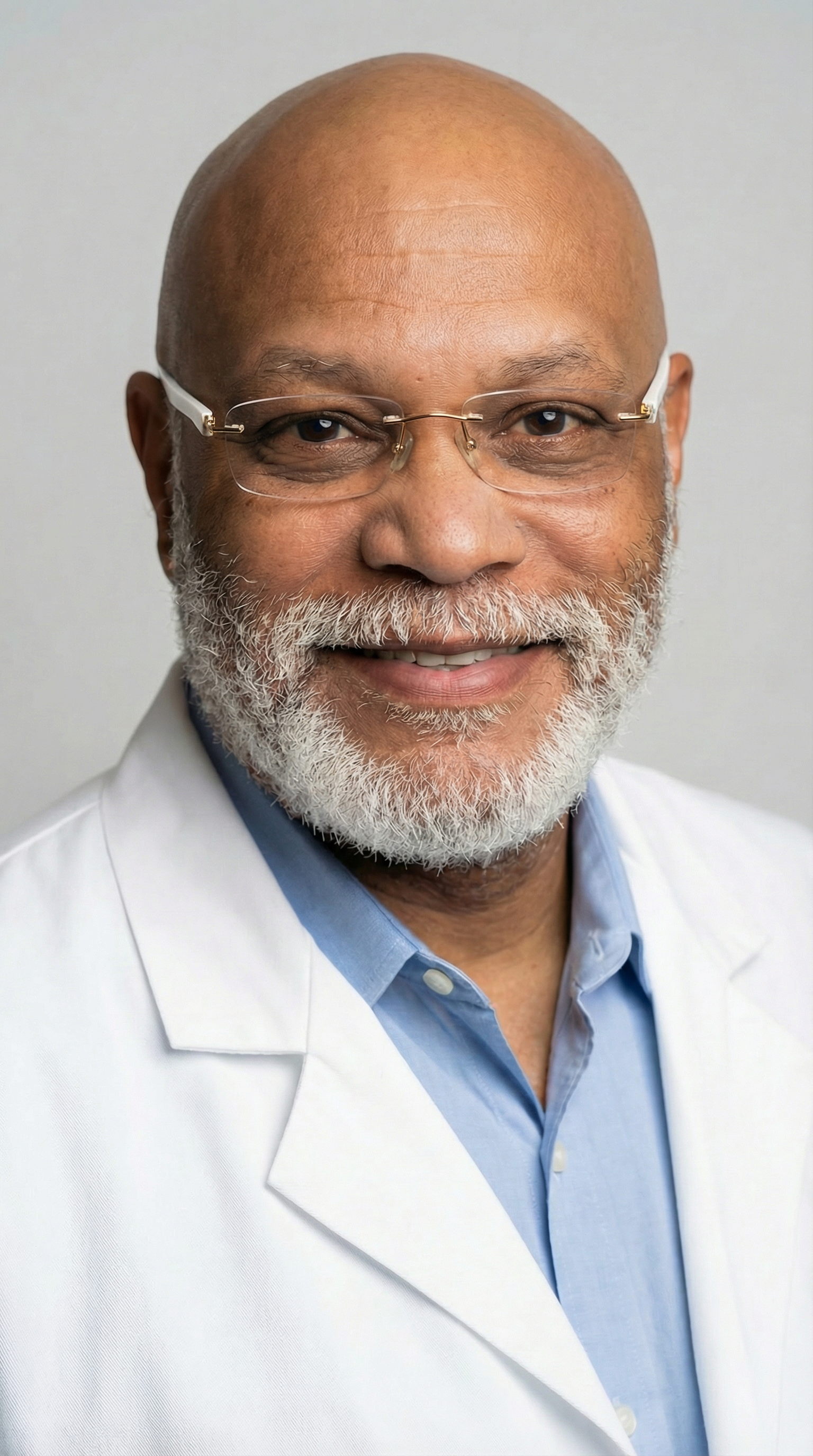
Clinically Reviewed By
Dr. James H. Singletary, OD, FIAOMC
Co-Founder · Myopia Control Specialist · Eye Medics Optometry
Last reviewed: March 2026 · View full bio →
What Is Pupillary Distance?
Pupillary distance — or PD — is the measurement in millimeters between the centers of your two pupils. It sounds simple. And in a way, it is. But that single number (or ideally, two numbers — one for each eye) determines where the optical center of your lens sits relative to your pupil. Get it right, and light travels in a straight line from the lens to your retina. Get it wrong, and your lens acts like a prism — bending light in a direction your eyes never asked for.
There are two types of PD every patient should know about. Binocular PD is the total distance from pupil center to pupil center — a single number, typically between 54 and 74 mm for adults, with a population average around 62–64 mm. Monocular PD measures each eye separately from the center of the nose bridge. Because most faces are not perfectly symmetric, your right eye might be 31 mm from center while your left is 33 mm. Modern lens dispensing — especially for progressive lenses — requires monocular PD. A single binocular number can hide asymmetry that causes real optical problems.
There is also a difference between distance PD (measured while you look at something far away) and near PD (measured while you look at something close). Because your eyes converge when you read, your near PD is typically 3–5 mm smaller than your distance PD. For reading glasses or the near zone of a progressive lens, near PD is the number that matters.
Why Getting It Right Matters
I have been practicing optometry for over 20 years, and I can tell you that incorrect PD is one of the most common — and most preventable — causes of patient dissatisfaction with new glasses. Patients come in complaining that their glasses give them headaches, make them dizzy, or feel "off." In many cases, the prescription is perfectly correct. The PD was wrong.
A 2023 study published in Health Science Reports (Bist et al.) examined real-world spectacle wearers and found that 57% were not looking through the optical center of their lenses. Of those, 40% reported asthenopic symptoms — headaches, eye strain, blurred vision, and fatigue. That is not a small number. That is the majority of glasses wearers walking around with lenses that are not doing their job.
The symptoms of incorrect PD are not always dramatic. Sometimes it is just a vague sense that something is not quite right — a slight tension behind the eyes after reading, a headache that appears reliably in the afternoon, a feeling that you are working harder than you should to see clearly. These are the symptoms that get blamed on the prescription, on the lens coating, on the frame, on everything except the one measurement that was never taken properly in the first place.
Why a Wrong PD Causes Real Problems
Even a small PD error shifts where light hits your lens, creating unwanted prism — an invisible bending of light that your eyes have to fight against. The result: headaches, eye strain, blurry vision, or glasses you simply can't adapt to. The stronger your prescription, the worse the effect.
💡 The simple version
Think of it this way: if your prescription is even moderate, a 3 mm PD error is like wearing someone else's glasses — your lenses are bending light in the wrong direction. The stronger your prescription, the worse a PD mistake hurts. That's not an opinion. It's physics.
Why Self-Measurement Fails
The internet is full of tutorials showing you how to measure your own PD with a ruler and a mirror. Online retailers promote smartphone apps that claim to measure your PD with "professional accuracy." The short answer: apps and mirrors can be off by 6 mm or more. A professional stays within 2 mm. For progressive lenses or stronger prescriptions, that difference is the gap between glasses that work and glasses that don't.
💡 The simple version
A mirror or app can be off by more than 6 mm — roughly the width of a pencil eraser sitting right between your pupils. For progressive lenses, the allowed error is only ±1 mm. A trained professional with a pupillometer stays within ±1.9 mm. There's no comparison.
The most rigorous peer-reviewed study on this question — McMahon, Irving & Lee (2012), published in Optometry and Vision Science — tested self-measurement methods against a trained examiner with a calibrated pupillometer. The results were unambiguous:
📏At Eye Medics, we use a calibrated digital pupillometer — the gold standard.
| Method | Error Range (95% LoA) | Reliable? | OK for Progressives? | OK for Children? |
|---|---|---|---|---|
| Digital Pupillometer (professional)✓ Used at Eye Medics | ±1.88 mm | |||
| PD Ruler (professional, proper technique) | ±2.3 mm | |||
| Self-measurement with mirror | ±6.14 mm | |||
| Friend measurement (untrained) | ±5.32 mm | |||
| Smartphone app (best case) | ±0.51–1.38 mm | |||
| Smartphone app (typical) | ±6.51 mm | |||
| Source: McMahon, Irving & Lee (2012), Optometry and Vision Science; Jung & Chu (2024), Clinical Optometry | ||||
A 95% limit of agreement of ±6.51 mm means that in 5% of cases, the error will be greater than 6.51 mm. That is not a rounding error. That is a clinically significant misalignment that will induce prism, cause symptoms, and — in the case of progressive lenses — render the glasses essentially unwearable for many patients.
More recent studies have found that the best smartphone apps perform better than the worst mirror measurements — but still fall short of professional standards for progressive lenses and high prescriptions. A 2023 Cureus study found that even the best-performing app (Warby Parker's) had a mean absolute error of 0.51 mm, while the worst reached 1.375 mm. For a low single-vision prescription, 0.51 mm may be acceptable. For a progressive lens or a prescription above ±3.00 D, it is not.
There is also a technical problem that no app can solve: fitting height, pantoscopic tilt, vertex distance, and wrap angle cannot be measured without the patient present and the frame on their face. These measurements are essential for progressive lens dispensing. Online retailers cannot collect them. A professional can.
Children and PD — A Special Case
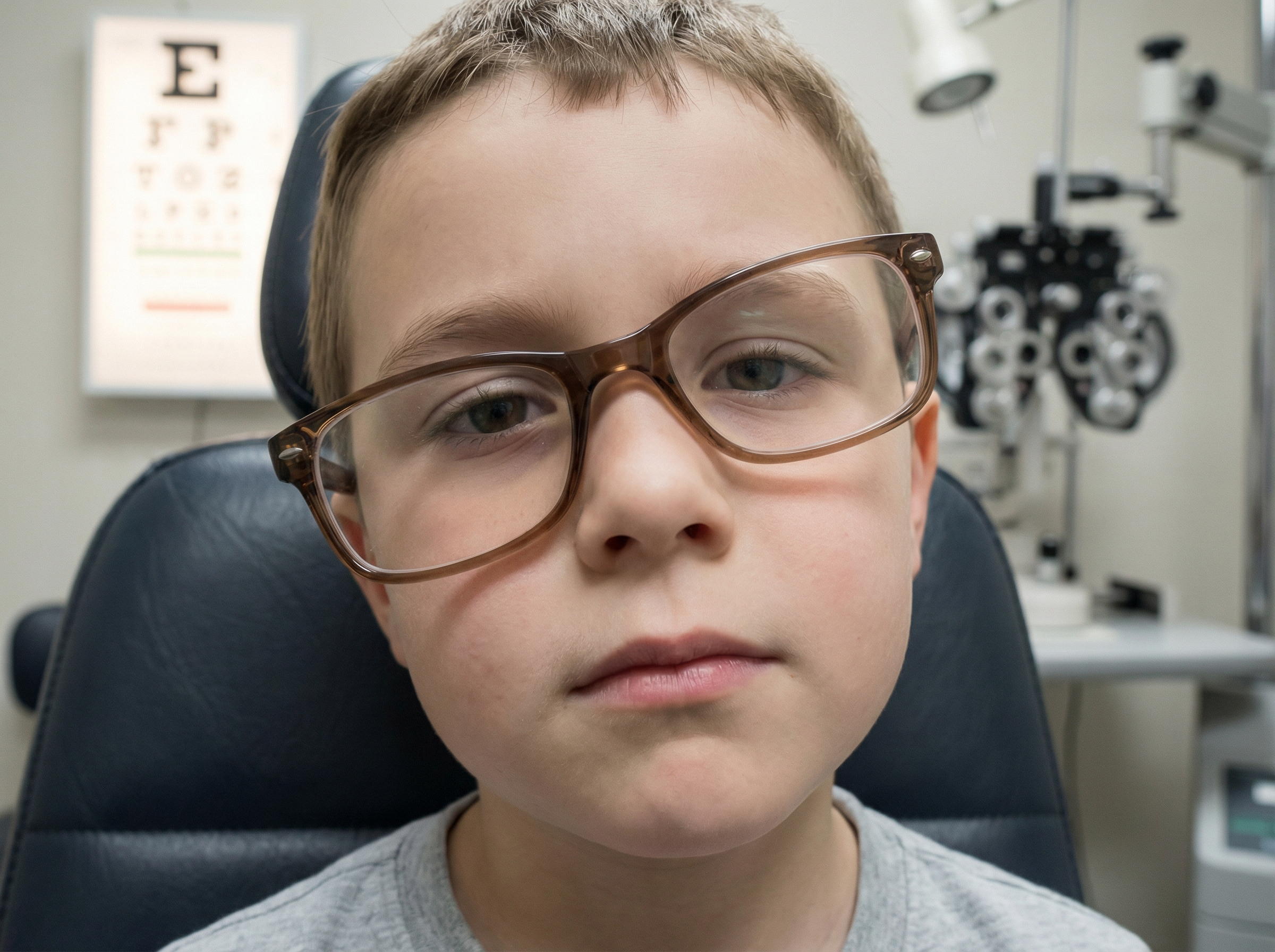
Glasses that are even slightly tilted can induce unwanted prism — a problem a trained professional catches immediately.

When glasses sit too low, the child looks over the lenses — defeating the entire purpose of wearing them.
Children present unique PD measurement challenges that make self-measurement not just inaccurate, but potentially harmful. A child's PD changes measurably year over year as the face grows. A newborn's interpupillary distance averages approximately 40 mm. By school age, it is around 55 mm. By late adolescence, it approaches the adult average of 62–65 mm. A PD that was correct at age 7 may be meaningfully wrong at age 9.
Children also cannot reliably report symptoms. An adult with incorrect PD will tell you their glasses give them headaches. A child may simply stop wearing their glasses, start squinting, tilt their head, or get labeled as inattentive in class. The 2024 Clinical Optometry study explicitly notes that children present "heightened technical challenges" for PD measurement — limited cooperation, inability to maintain fixation, and facial proportions that differ significantly from adult norms.
Children with strabismus (misaligned eyes) require especially precise monocular PD measurement. The standard binocular method can produce a clinically misleading result in these patients. And the AOA's own study found that 25% of children's lenses ordered online failed impact resistance testing — a safety failure that compounds the accuracy problem.
When I measure a child's PD, I take the time to get it right — both eyes separately, at the appropriate working distance, with the frame the child will actually wear. That is not something a mirror or an app can replicate.
What a Professional Measures
When you come in for a professional PD measurement, here is what actually happens — and why each step matters:
Distance monocular PD (right and left separately)
Measured with you fixating on a distant target. This is the number used for the distance zone of progressive lenses and all distance single-vision lenses.
Near monocular PD (right and left separately)
Measured with you fixating at 40 cm — the typical reading distance. Used for reading glasses and the near zone of progressive lenses.
Fitting height
For progressive lenses, the vertical position of your pupil center relative to the bottom of the frame — measured with the actual frame on your face. This cannot be done without you present.
Pantoscopic tilt
The angle of the frame relative to your face. A frame that tilts forward or back changes the effective optical center position and must be accounted for in lens fabrication.
Vertex distance
The distance from the back surface of the lens to your cornea. Critical for high prescriptions — a change of even 1–2 mm changes the effective power of the lens.
💡 What this means for you
Steps 3–5 above — fitting height, pantoscopic tilt, and vertex distance — are measurements that simply cannot be done without you sitting in the chair with your actual frames on your face. No app, no website, no online retailer can collect them. These are the measurements that make the difference between progressive lenses you love and progressive lenses you return.
The Art of Clinical Practice in Optometry — a professional training text — contains a candid admission worth sharing: "PD measurement is a procedure that is often undertaken incorrectly by novices and those that rush." Even within the professional community, PD measurement requires proper training and attention. It is not a measurement that can be reliably delegated to a patient with a mirror and a smartphone.
North Carolina Law & Your Rights
Patients sometimes ask whether we are legally required to give them their PD. The answer in North Carolina is no — and here is why that is actually the right policy.
The FTC Eyeglass Rule (most recently updated June 2024) requires eye doctors to provide patients with a copy of their spectacle prescription after an examination, at no charge. However, the Rule does not require PD to be included in the prescription, and it does not prohibit charging a fee for PD measurement as a separate service. Only four states have specific PD requirements: Kansas, Alaska, New Mexico, and Massachusetts. North Carolina is not among them.
The reason PD is not part of the prescription in most states is that it is a dispensing measurement, not a prescription element. Your prescription tells a lab what optical power to grind into a lens. Your PD tells a lab where to center that lens in your frame. The second measurement depends on the frame you choose — which is why it is properly done at the point of dispensing, with the actual frame on your face.
💡 What this means for you
Bottom line: in North Carolina, your eye doctor is required to give you your prescription — but not your PD. That's because PD is a fitting measurement, not a prescription element. It depends on the frame you choose. Charging a small fee for a professional measurement that protects your vision and your investment is not only legal — it's the right thing to do.
We charge $25 for a standalone PD measurement. We believe that is a fair price for a professional service that protects your vision and your investment in your glasses. If your PD is measured as part of a comprehensive eye exam, there is no additional charge.
The Online Glasses Problem
I want to be clear: I am not opposed to online eyewear. For low single-vision prescriptions, a patient who knows their PD accurately and chooses a simple frame can get a functional pair of glasses online. The economics are real, and I understand why patients explore that option.
But the data on online eyewear quality is sobering. The AOA's 2011 study examined 200 pairs of glasses ordered from online retailers and found that 44.8% had incorrect prescriptions or safety issues, 29% had at least one lens fail to meet required prescription standards, and 25% of children's lenses failed impact resistance testing. A 2019 UK investigation found that 7 of 26 pairs of glasses purchased online failed quality tests — particularly for high prescriptions and progressive lenses.
Even Fittingbox, a company that sells digital measurement technology to online retailers, acknowledges that "over 72% of eyewear e-commerce returns are due to incorrect measurements, including pupillary distance." That statistic, from an industry insider, is the most honest assessment of the online glasses PD problem you will find.
💡 What this means for you
Nearly half of glasses ordered online have prescription or safety problems. And the company that sells digital fitting technology to online retailers admits that over 72% of online eyewear returns are caused by wrong measurements — including PD. If you're buying glasses online, a $25 professional PD measurement is the single best thing you can do to protect that purchase.
If you are buying glasses online, get your PD measured professionally first. The $25 you spend here could save you from a $150 pair of glasses that gives you headaches, a $300 pair of progressives you cannot adapt to, or — in the case of your child — a pair of glasses that is actively making their vision worse.
Our $25 PD Measurement Service
Professional PD Measurement
Why trust a mirror
when you can trust a pupillometer?
- Digital pupillometer — gold-standard accuracy (±1.88 mm)
- Monocular PD measured — each eye separately
- Distance & near PD — critical for progressives
- Pediatric-friendly — we see kids of all ages
- Results in 5 minutes — walk-ins welcome
One-time fee
Not billed to insurance · Cash pay
Call to ScheduleRequest Online910.426.3937 · Fayetteville, NC
We serve patients throughout Fayetteville, Fort Liberty, Hope Mills, Spring Lake, Raeford, and all of Cumberland County. If you are a military family at Fort Liberty, we accept TRICARE for comprehensive eye exams — and the $25 PD measurement fee is available as a standalone service for anyone who needs it, regardless of insurance.
If your PD is measured as part of a comprehensive eye exam at Eye Medics, there is no additional charge. The $25 fee applies only to standalone PD measurements — patients who are buying glasses elsewhere and need an accurate PD first.
Frequently Asked Questions
References & Further Reading
- McMahon TT, Irving EL, Lee J. (2012). Self-measurement of interpupillary distance. Optometry and Vision Science, 89(5), 749–756.
- Jung H, Chu S. (2024). Comparative analysis of interpupillary distance measurement techniques. Clinical Optometry, 16, 1–11. PMC11654209.
- Bist J, et al. (2023). Optical center misalignment in single-vision spectacles. Health Science Reports.
- Carlson NB, Kurtz D, Heath DA. (2016). Clinical Procedures for Ocular Examination, 4th Edition. McGraw-Hill.
- FTC Eyeglass Rule (16 CFR Part 456), updated June 2024. ftc.gov
- AOA / Optical Laboratories Association / The Vision Council. (2011). Online Eyeglass Prescription Study. Southern College of Optometry.
- Alderson AJ, et al. (2016). Spectacles purchased online vs. optometry practice. Ophthalmic and Physiological Optics.
- College of Optometrists (UK). Clinical Management Guideline A346: Pupillary Distance. college-optometrists.org
Medical Disclaimer
This page is for informational purposes only and does not constitute medical advice, diagnosis, or treatment. The information provided here should not be used as a substitute for professional medical advice from a qualified eye care provider. Always consult with a licensed optometrist or ophthalmologist regarding any eye health concerns, symptoms, or treatment decisions.
Let Us Measure Your PD — The Right Way
Five minutes. $25. Done right. Serving Fayetteville, Fort Liberty, Hope Mills, Spring Lake, and all of Cumberland County.
