
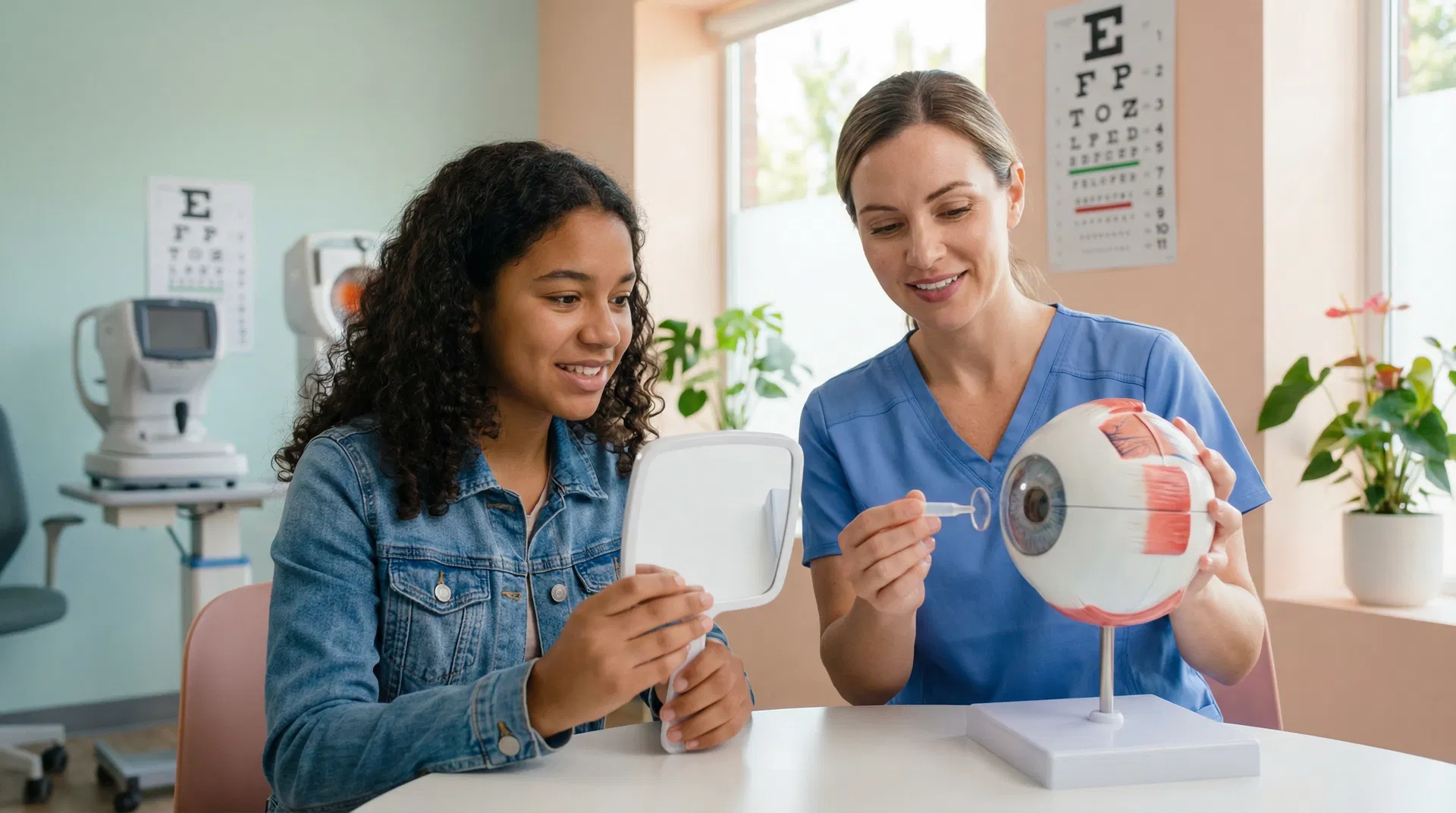
Quick Answer: What Age Can Kids Start Wearing Contact Lenses?
There's no single "right age" — it depends on maturity and responsibility, not a number. Most children are ready between ages 10 and 14, but some motivated younger children do well. The key factors are whether the child can handle the insertion/removal routine independently, will follow the wear schedule, and is genuinely motivated. A contact lens fitting consultation can help determine if your child is ready.
Contact lenses have come a long way. The materials are better, the options are broader, and the fitting process is more precise than ever. Whether you're a teenager trying contacts for the first time, an adult who's worn the same brand for years and wants to know if there's something better, or a parent whose child's myopia keeps getting worse — there's a good chance we can help.
At Eye Medics Optometry in Fayetteville, NC, we fit contact lenses for patients of all ages — from kids as young as 8 or 9 who are motivated and responsible, to adults in their 60s and 70s who want the freedom of not wearing glasses. We serve families throughout Cumberland County, including Hope Mills, Spring Lake, Raeford, and Fort Liberty.
What's the Right Age for Contact Lenses?
Parents ask me this constantly, and my honest answer is: it's less about age and more about the individual child. I've fit 10-year-olds who were more careful and diligent about their lens care than some adults I see. And I've had 15-year-olds who clearly weren't ready.
The questions I ask when evaluating a child for contact lenses:
Can they insert and remove lenses independently?
This is a skill — it takes practice. We teach it in the office.
Will they follow the wear schedule?
Overwearing is the #1 cause of contact lens complications in teens.
Are they motivated by themselves?
Peer pressure is not a good reason to start contacts. Genuine desire is.
Can they handle the hygiene routine?
Handwashing before handling lenses is non-negotiable.
If the answers are mostly yes, we schedule a contact lens fitting consultation. If there are concerns, we talk through them honestly — sometimes the answer is "let's try it and see," sometimes it's "let's wait six months."
Types of Contact Lenses We Fit
Not all contact lenses are the same — and the right lens for you depends on your prescription, lifestyle, eye health, and goals. Here's an overview of what we offer:
| Lens Type | Best For | Replacement | Myopia Control? |
|---|---|---|---|
| Daily Disposable Soft | First-time wearers, teenagers, occasional wear, dry eye patients | Daily | MiSight 1-day (FDA-approved for myopia control) |
| Monthly Soft Lenses | Full-time wearers committed to a cleaning routine | Every 30 days | Some multifocal options available |
| Toric Soft Lenses | Patients with astigmatism who need stable, clear vision | Daily or monthly | Limited options |
| Orthokeratology (Ortho-K) | Myopia control; patients who want glasses-free days without surgery | Worn overnight; replaced every 1–2 years | Yes — one of the most effective myopia control options |
| Multifocal / Progressive | Adults over 40 with presbyopia; also used for myopia control in children | Daily or monthly | Yes — center-distance multifocals slow myopia progression |
| Scleral Lenses | Irregular corneas (keratoconus), severe dry eye, post-surgical patients | Every 1–2 years | Not typically used for myopia control |
Source: American Optometric Association Contact Lens Care Guidelines
What Happens at a Contact Lens Fitting
A contact lens fitting is separate from — and in addition to — your comprehensive eye exam. Here's what it involves:
1. Corneal Measurements
We measure the curvature of your cornea to determine the right base curve and diameter for your lenses. An ill-fitting lens is uncomfortable and can cause corneal damage over time.
2. Trial Lens Selection
Based on your prescription and measurements, we select trial lenses for you to try on. For specialty lenses like toric or multifocal, we may try several options to find the best fit.
3. Fit and Vision Assessment
We evaluate how the lenses sit on your eye, check for proper movement and centration, and verify that your vision is clear and comfortable.
4. Insertion and Removal Training
For new wearers, we spend time teaching proper insertion and removal technique. Most people get it within 20 to 30 minutes. Some need a second session — that's completely normal.
5. Wear Schedule and Care Instructions
We go over exactly how long to wear your lenses, how to care for them, and what warning signs to watch for. This is not optional — it's the most important part of the appointment.
6. Follow-Up Visit
We schedule a follow-up 1 to 2 weeks later to check on comfort, vision, and corneal health. This is where we finalize the prescription and order your supply.
Contact Lenses for Myopia Control
If your child's prescription is getting stronger every year, this section is especially important. Myopia (nearsightedness) is not just an inconvenience — high myopia significantly increases the lifetime risk of retinal detachment, glaucoma, and macular degeneration. Slowing the progression during childhood can have a major impact on long-term eye health.
Two contact lens options have strong clinical evidence for myopia control:
MiSight 1-Day Soft Lenses
The first and only FDA-approved soft contact lens for myopia control in children. Worn daily and discarded each night. Clinical trials showed an average 59% reduction in myopia progression over 3 years.
Best for: Ages 8–15, motivated daily wearers
Orthokeratology (Ortho-K)
Rigid gas-permeable lenses worn overnight that gently reshape the cornea. You wake up and see clearly all day without any lenses. Also slows myopia progression by approximately 40–60% in clinical studies.
Best for: Active kids, athletes, patients who prefer glasses-free days
We offer both options at Eye Medics. If your child's myopia is progressing, schedule a pediatric eye exam and ask specifically about myopia control — we'll evaluate whether they're a good candidate and discuss the options in detail.
Contact Lens Safety: What Every Patient Needs to Know
Contact lenses are extremely safe when used correctly. The problems happen when people cut corners. Here's what the data shows about the behaviors that put eyes at risk:
Contact Lens Infection Risk by Behavior
Relative risk compared to proper daily care. (Source: CDC, British Journal of Ophthalmology)
The most dangerous habit: Sleeping in contact lenses — even occasionally — dramatically increases the risk of microbial keratitis, a corneal infection that can cause permanent vision loss. If you fall asleep in your lenses occasionally, it happens — but make it the exception, not the rule.
Daily Lens Care Habits That Protect Your Eyes
These aren't suggestions — they're the habits that separate patients who wear contacts for decades without problems from those who end up in the emergency room with a corneal infection:
Wash hands before touching lenses
Every single time. No exceptions.
Replace lenses on schedule
A 'two-week' lens means two weeks — not 'until it feels uncomfortable.'
Never sleep in lenses
Unless specifically prescribed for overnight wear by your doctor.
Never use tap water
Tap water can harbor Acanthamoeba — a parasite that can destroy the cornea.
Replace your lens case monthly
Cases harbor biofilm even when cleaned. Replace it when you open a new bottle of solution.
Remove lenses before swimming
Lakes, pools, and hot tubs are all contaminated with organisms that can infect the eye.
If your eyes ever become red, painful, or light-sensitive while wearing contacts — remove them immediately and call us. Don't wait to see if it gets better. Corneal infections move fast, and early treatment makes a huge difference. Learn more about eye health at the American Optometric Association's contact lens resource center.
Insurance and Coverage
Most vision insurance plans include an annual contact lens benefit that covers the fitting fee and provides an allowance toward lens purchases. We accept TRICARE, VSP, EyeMed, Blue Cross Blue Shield, and most other major plans.
TRICARE Prime & Select
VSP Vision Care
EyeMed
Blue Cross Blue Shield
Aetna / Cigna / United
Medicaid / NC Health Choice
Specialty lenses — including Ortho-K and scleral lenses — may require additional out-of-pocket costs beyond the standard vision benefit. We'll give you a clear cost breakdown before you commit to anything. Call us at 910.426.3937 to verify your benefits.
Frequently Asked Questions
Last reviewed: February 2026 by Dr. James H. Singletary, OD, FIAOMC
Ready to Try Contact Lenses?
Whether it's your first time or you're looking for a better fit, we'll find the right lens for your eyes and your lifestyle. Serving Fayetteville, Hope Mills, Spring Lake, Raeford, and Fort Liberty.
Book a Contact Lens Fitting