
Post-LASIK & Post-Surgical Contacts
LASIK changed your life — until it didn't. If your vision has regressed or your cornea changed after surgery, specialty contact lenses can get you back to seeing clearly.
When LASIK Isn't Enough
I want to be clear about something: LASIK is a genuinely good procedure. For the right patient, it works beautifully. But I've been in practice long enough to know that "LASIK worked" isn't always the end of the story.
In Fayetteville, I see a steady stream of patients — many of them active duty or veterans from Fort Liberty — who had LASIK years ago and are now dealing with vision that's drifted back, or dry eyes that never fully recovered, or glare and halos that make night driving miserable. Some had excellent results for a decade and then noticed things getting blurry again. Others had complications from the start.
Here's the thing: when LASIK changes the shape of your cornea, it changes it permanently. That means standard contact lenses — the kind designed for a normal, spherical cornea — often don't work well anymore. The lens just can't conform to the new shape. That's where specialty contact lenses come in.
Why Regular Contacts Fail After Surgery
A standard soft contact lens is designed to drape over a smooth, spherical cornea. After LASIK, your cornea is flatter in the center (for nearsightedness correction) or steeper (for farsightedness). After PRK or RK, the shape is different still. After a corneal transplant, it can be wildly irregular.
When a soft lens tries to sit on an irregular surface, it can't create a smooth optical interface. You get distortion, ghosting, halos, and blur — even with the "right" prescription. Patients often describe it as looking through a scratched windshield. The prescription is technically correct, but the optics are off.
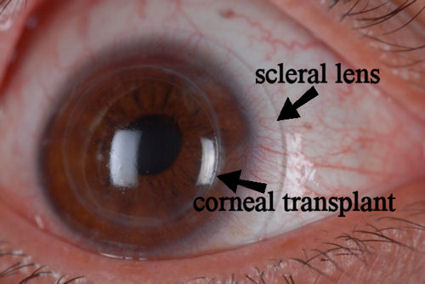
Specialty lenses — particularly scleral lenses — solve this by vaulting completely over the cornea and landing on the white of the eye. The space between the lens and the cornea fills with a reservoir of saline solution, creating a perfectly smooth, tear-filled optical surface. The result is dramatically clearer vision, often better than anything glasses or soft contacts can provide.
Conditions We Treat
Not every post-surgical patient needs specialty lenses, but many do. Here are the most common situations I see in my practice:
| Condition | What It Means | Best Lens Option |
|---|---|---|
| LASIK Regression | Vision drifts back toward original prescription over months or years | Soft toric or scleral lenses |
| Post-LASIK Ectasia | Cornea weakens and bulges after surgery — similar to keratoconus | Scleral lenses (often + cross-linking) |
| Irregular Astigmatism | Corneal surface becomes uneven, causing distortion standard lenses can't fix | Scleral or RGP lenses |
| Post-PRK / Post-RK | Corneal shape altered by photorefractive keratectomy or radial keratotomy | Scleral or hybrid lenses |
| Post-Corneal Transplant | Donor cornea has different shape than original; highly irregular surface | Scleral lenses |
| Chronic Dry Eye Post-LASIK | LASIK severs corneal nerves, reducing tear production for months or years | Scleral lenses (fluid reservoir soothes the eye) |
* Table reflects general clinical guidelines. Individual treatment plans vary based on corneal mapping, visual acuity, and patient history.
Your Specialty Lens Options
There's no single "best" lens for every post-surgical patient. The right choice depends on the degree of corneal irregularity, how much dry eye is involved, and your lifestyle. Here's how I think about it:
Scleral Lenses
Most CommonMy first choice for most post-surgical patients. Large diameter, vaults over the cornea, fluid reservoir soothes dry eye. Best for ectasia, irregular astigmatism, and post-transplant patients.
RGP (Rigid Gas Permeable) Lenses
Smaller than sclerals, sit directly on the cornea. Excellent optics for mild-to-moderate irregularity. Less comfortable than sclerals but easier to insert and remove.
Hybrid Lenses
Rigid center for sharp optics, soft skirt for comfort. A good middle ground for patients who can't tolerate RGPs but need better optics than soft lenses provide.
Custom Soft Lenses
For mild regression or mild irregular astigmatism. More comfortable than rigid options, but optics are limited. Best for patients with only minor corneal changes.
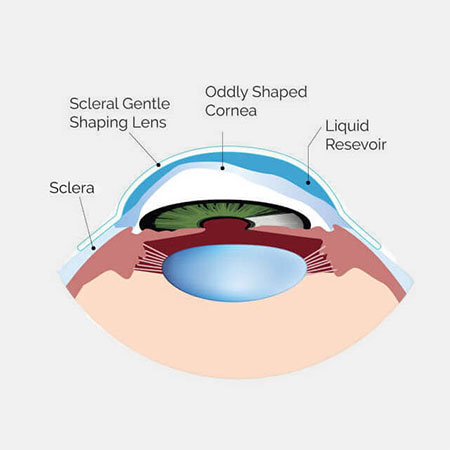
Scleral lens cross-section showing the fluid reservoir that vaults over the irregular corneal surface.
Lens Comparison Chart
Here's a quick side-by-side to help you understand how the main options stack up for post-surgical patients:
| Feature | Scleral | RGP | Hybrid | Custom Soft |
|---|---|---|---|---|
| Vision quality (irregular cornea) | ★★★★★ | ★★★★☆ | ★★★★☆ | ★★★☆☆ |
| Comfort | ★★★★☆ | ★★★☆☆ | ★★★★☆ | ★★★★★ |
| Dry eye relief | ★★★★★ | ★★☆☆☆ | ★★★☆☆ | ★★☆☆☆ |
| Ease of insertion | ★★★☆☆ | ★★★★☆ | ★★★★☆ | ★★★★★ |
| Best for ectasia | ✅ Yes | ✅ Yes | ⚠️ Mild only | ❌ No |
| TRICARE covered | ✅ If medically necessary | ✅ If medically necessary | ⚠️ Varies | ✅ Usually |
What the Fitting Process Looks Like
I want to set realistic expectations here, because fitting specialty lenses after surgery is not the same as a routine contact lens exam. It takes more time, more precision, and more follow-up. But the payoff is real.
Corneal Topography Mapping
We start with a detailed 3D map of your corneal surface. This tells us exactly how irregular the shape is and which lens design will vault over it correctly.
Trial Lens Selection
Based on your topography, we select a trial lens and place it on your eye. We evaluate the fit under a slit lamp — checking the vault height, edge alignment, and how the lens moves.
Over-Refraction
With the trial lens in place, we refine the prescription to get you the sharpest possible vision. This is often the moment patients say 'I haven't seen this clearly in years.'
Final Lens Order & Training
Once the fit is confirmed, we order your custom lenses. When they arrive, we train you on insertion, removal, and care. Most patients are comfortable within a week.
The full process typically takes 2–4 visits over 4–6 weeks. Some patients with complex corneas need more adjustments. We don't rush it — getting the fit right is what makes the difference between lenses you'll actually wear and lenses that sit in a drawer.
Fort Liberty & TRICARE Coverage
We see a lot of active duty service members and veterans from Fort Liberty who had LASIK through the military — it's one of the most common refractive surgeries performed on service members. Years later, some of them find their vision has changed, or they're dealing with dry eye that never fully resolved.
TRICARE covers medically necessary specialty contact lenses when there's a documented complication from refractive surgery — including ectasia, significant irregular astigmatism, and severe dry eye. The key word is "medically necessary," which means we need proper documentation of the condition and its impact on your vision.
Our team handles the TRICARE verification process before we start. We'll tell you upfront what's covered and what isn't so there are no surprises. Call us at (910) 426-3937 to get started.
Related Services at Eye Medics
Frequently Asked Questions
References & Further Reading
Medical Disclaimer
This page is for informational purposes only and does not constitute medical advice, diagnosis, or treatment. The information provided here should not be used as a substitute for professional medical advice from a qualified eye care provider. Always consult with a licensed optometrist or ophthalmologist regarding any eye health concerns, symptoms, or treatment decisions.
LASIK Didn't Give You the Vision You Expected?
Schedule a specialty lens consultation with Dr. Singletary. We'll map your cornea, explain your options, and find the lens that works for your post-surgical eye.
