
Specialty Contact Lenses
When standard contacts don't cut it — we have options that actually work.
What Are Specialty Contact Lenses?
Most people think of contact lenses as those thin, soft discs you pop in every morning. And for a lot of patients, that works great. But there's a whole category of lenses that most people never hear about — until they really need them.
Specialty contact lenses are custom-designed lenses for patients whose eyes can't be corrected well with standard soft contacts. That includes people with irregular corneas, high prescriptions, severe dry eye, or conditions like keratoconus. These lenses are larger, more rigid, or specifically shaped to work around the unique anatomy of your eye.
In my practice, I fit specialty lenses regularly. Some patients come in after years of frustration — they've tried every soft lens on the market and still can't see clearly. Others come in right after a keratoconus diagnosis, wondering what their options are. Either way, specialty lenses are usually the answer.
Who Needs Specialty Lenses?
If any of these sound familiar, specialty lenses are worth a conversation:
Keratoconus
Irregular cone-shaped cornea that soft lenses can't correct
Post-LASIK or post-transplant
Corneal surface changed by surgery — standard lenses don't fit right
Irregular astigmatism
Astigmatism that glasses and soft lenses can't fully correct
Severe dry eye
Eyes too dry to tolerate standard soft lenses comfortably
High myopia or hyperopia
Prescriptions beyond what soft lenses can reliably correct
Myopia in children
Ortho-K can slow progression while eliminating daytime lenses
A lot of patients in Fayetteville come to me after being told by another provider that they're "hard to fit." That's not a dead end — it's just a signal that you need someone with the right equipment and experience. We have both.
Types of Specialty Contact Lenses
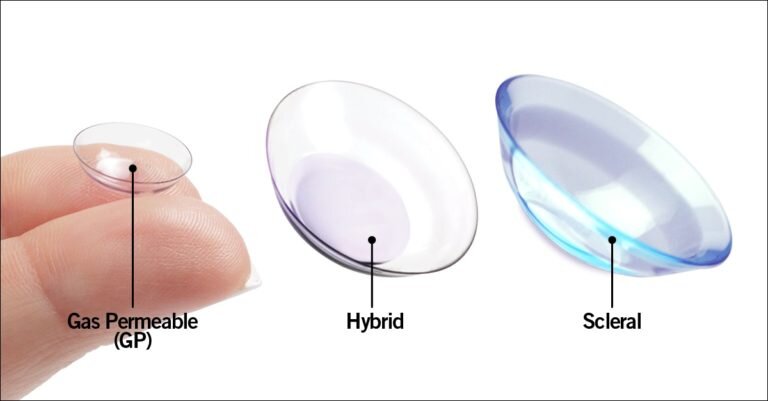
There are four main types we use in our practice. Each one has a different design, a different fitting process, and a different set of conditions it works best for.
Scleral Lenses: Our Most-Used Tool
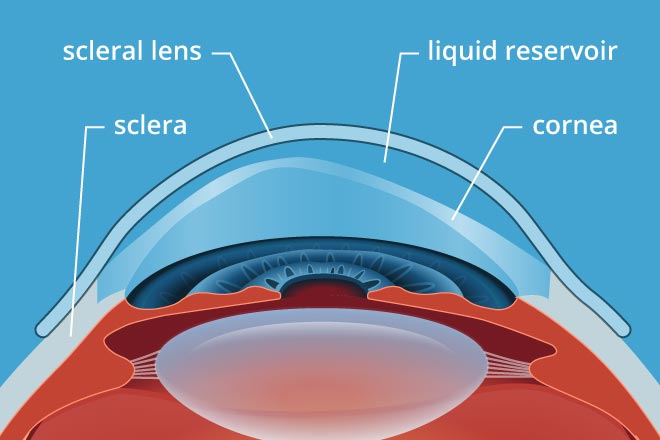
If I had to pick one lens that's changed the most lives in my practice, it's scleral lenses. These are large-diameter rigid lenses — typically 16–22mm across — that vault completely over the cornea and rest on the white of the eye (the sclera). The space between the lens and the cornea fills with saline solution, creating a smooth, stable optical surface regardless of what your cornea looks like underneath.
Here's why that matters. If you have keratoconus, your cornea is shaped like a cone instead of a smooth dome. A soft lens just drapes over that cone — it can't create a clear image. A scleral lens ignores the shape of your cornea entirely. The fluid reservoir fills in all the irregularities. What you get is sharp, stable vision that glasses and soft lenses simply can't provide.
Scleral lenses are also a game-changer for dry eye patients. The saline reservoir keeps the eye lubricated all day. I've had patients who couldn't wear any contact lens for years — not even the most hydrating soft lens — who now wear sclerals comfortably for 12–14 hours a day.
| Feature | Scleral Lens | Standard Soft Lens |
|---|---|---|
| Diameter | 16–22 mm | ~14 mm |
| Corneal contact | None — vaults over cornea | Drapes directly on cornea |
| Vision quality (irregular cornea) | Excellent — fluid fills gaps | Poor — conforms to irregularity |
| Dry eye comfort | Excellent — saline reservoir | Variable — often poor |
| Stability on eye | Very stable — rests on sclera | Can shift or dislodge |
| Best for | Keratoconus, dry eye, post-surgical | Normal corneas, mild Rx |
Rigid Gas Permeable (RGP) Lenses
RGP lenses — sometimes called hard lenses or GP lenses — are smaller than sclerals (about 9–10mm) and rest directly on the cornea. They're rigid, so they hold their shape over an irregular cornea and create a smooth front surface for light to pass through. The result is sharper vision than soft lenses can provide for many patients.
The tradeoff is comfort. RGP lenses have a longer adaptation period than soft lenses — most patients need 2–4 weeks before they feel natural. And because they sit on the cornea, they can occasionally dislodge. For active patients or those with more advanced corneal irregularity, scleral lenses are often a better fit.
That said, RGP lenses are a solid option for mild to moderate keratoconus, high astigmatism, and patients who want a smaller, lighter lens. They're also less expensive than sclerals, which matters when insurance coverage is limited.
Hybrid Lenses
Hybrid lenses are exactly what they sound like — a rigid gas-permeable center surrounded by a soft outer skirt. You get the optical clarity of a rigid lens with the comfort of a soft lens. They're a good middle ground for patients who need better vision than soft lenses provide but struggle with the adaptation period of RGP lenses.
The most common hybrid lens brand is SynergEyes. They work well for mild to moderate keratoconus, irregular astigmatism, and patients transitioning from soft lenses who want better vision without fully committing to a rigid lens.
One limitation: hybrid lenses don't vault as completely over the cornea as sclerals do, so they're not the best choice for advanced keratoconus or severe dry eye. But for the right patient, they're a great option.
Orthokeratology (Ortho-K)
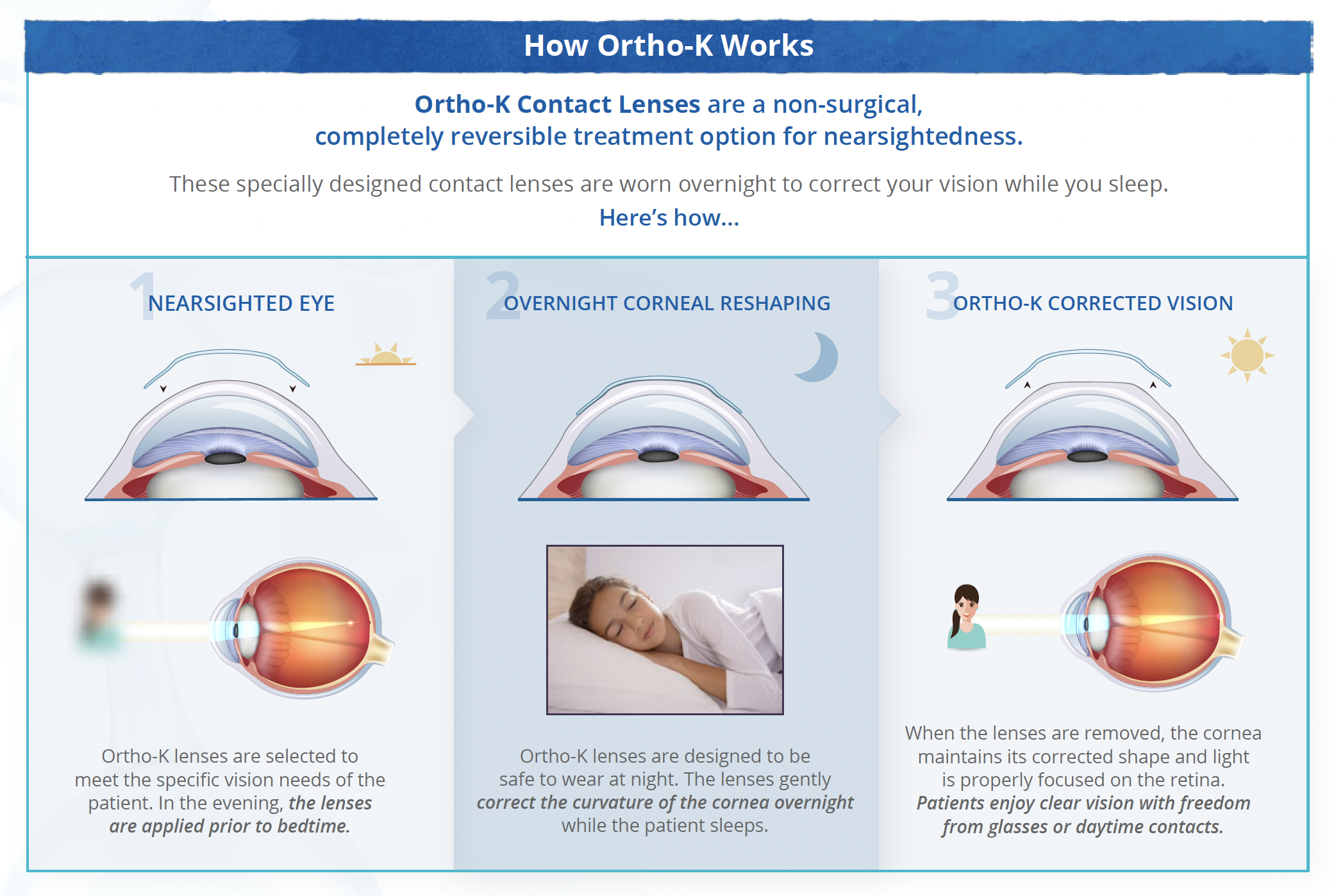
Ortho-K is the one that surprises people the most. You wear specially designed rigid lenses overnight, they gently reshape the front of your cornea while you sleep, and when you take them out in the morning — you can see clearly all day without glasses or contacts. No surgery. Completely reversible.
We use Ortho-K primarily for two groups of patients. First, children and teenagers with myopia (nearsightedness) — because Ortho-K doesn't just correct vision, it actually slows myopia progression. Studies show it can reduce the rate of myopia worsening by 30–60% compared to glasses. For a kid in Cumberland County schools whose prescription keeps getting worse every year, that's a big deal.
Second, adults who want freedom from daytime correction — athletes, people who work in dusty or dry environments, or anyone who just doesn't want to deal with contacts or glasses during the day. Ortho-K works best for mild to moderate myopia (up to about -6.00 diopters).
Ortho-K at Eye Medics — What to Expect
We offer the sleepSEE® Ortho-K program for myopia control in children and teens. Fittings typically take 3–4 visits. Most patients achieve functional daytime vision within the first week. Full results usually stabilize by week 3–4. Learn more at our sleepSEE® Myopia Control page.
Which Lens Is Right for You?
There's no universal answer. The right lens depends on your diagnosis, your lifestyle, and your eyes. Here's how I think about it:
| Lens Type | Best For | Comfort | Typical Cost |
|---|---|---|---|
| Scleral | Keratoconus, dry eye, post-surgical | Excellent | $1,500–$4,000 |
| RGP | Mild–moderate KC, high astigmatism | Moderate (adapts) | $500–$1,500 |
| Hybrid | Mild KC, irregular astigmatism | Good | $800–$2,000 |
| Ortho-K | Myopia control (kids & adults) | Excellent (worn at night) | $1,200–$2,500 |
* Cost ranges are estimates for fitting fees and initial lenses. Insurance coverage varies. We verify benefits before starting any fitting.
The Fitting Process
Specialty lens fitting is not the same as a standard contact lens exam. It starts with detailed corneal mapping — we use corneal topography and, for scleral fittings, scleral profilometry to measure the exact shape of your eye. This data drives the lens design.
From there, we order a trial lens. You come in, we put it in, evaluate the fit under the slit lamp, and check your vision. Then we make adjustments. For most patients, this process takes 3–5 visits spread over 4–8 weeks. I know that sounds like a lot, but a lens that's 95% right isn't good enough. We're aiming for perfect.
Once we land on the right fit, we order your final lenses. Most specialty lenses last 1–2 years with proper care. We'll see you for follow-up visits every 6–12 months to make sure the fit is still optimal and your prescription hasn't changed.
Corneal Mapping
Topography and profilometry create a detailed 3D map of your cornea and sclera.
Trial Lens Fitting
We select a starting lens based on your maps and evaluate fit and vision at the slit lamp.
Refinement Visits
Adjustments are made to diameter, vault, and power until fit and vision are optimal.
Final Lens Order
Custom lenses are manufactured to your exact specifications.
Dispensing & Training
We teach you insertion, removal, and cleaning. You leave confident.
Follow-Up Care
Annual or semi-annual visits to maintain optimal fit as your eyes change.
Insurance & TRICARE Coverage
We're in Fayetteville — home of Fort Liberty, one of the largest military installations in the country. A significant portion of my patients are active duty, veterans, and their families. So let me address TRICARE directly.
TRICARE covers medically necessary specialty contact lenses in most cases. That includes scleral lenses for keratoconus, RGP lenses for irregular astigmatism, and Ortho-K for myopia control in some plans. The key word is "medically necessary" — which means we need documentation of the condition and why standard lenses are insufficient. We handle that paperwork.
For non-TRICARE patients, Blue Cross Blue Shield, Aetna, and most major commercial plans have some specialty lens coverage. VSP and EyeMed — the two most common vision plans — typically don't cover specialty lenses beyond a standard allowance, but your medical insurance often will if there's a documented diagnosis.
Fort Liberty Families — We've Got You
We understand military life — deployments, frequent moves, the importance of maintaining vision readiness. We work with TRICARE regularly and will verify your specific benefits before we start any fitting. Call us at 910.426.3937 and we'll walk you through your coverage.
Related Services
10 Questions Checklist
Free PDF
Free Download
Specialty Lens Patient Checklist
10 questions to ask before your specialty lens fitting — insurance coverage, lens types, fitting timeline, and more. Enter your email and download instantly.
No spam. Unsubscribe anytime. We respect your privacy.
Frequently Asked Questions
References
Medical Disclaimer
This page is for informational purposes only and does not constitute medical advice, diagnosis, or treatment. The information provided here should not be used as a substitute for professional medical advice from a qualified eye care provider. Always consult with a licensed optometrist or ophthalmologist regarding any eye health concerns, symptoms, or treatment decisions.
Ready to See What Specialty Lenses Can Do?
If you've been told you're hard to fit, or if glasses and regular contacts just aren't cutting it — let's talk. We fit specialty lenses for patients across Fayetteville, Fort Liberty, Hope Mills, and Cumberland County.
