What Is Myopia Progression?
Myopia — what most people call nearsightedness — means your child can see things up close just fine, but anything in the distance looks blurry. That part most parents already know. What surprises them is learning that myopia isn't just a static condition you correct with glasses. It's a progressive disease — one that tends to get worse year after year during childhood and adolescence.
In my practice here in Fayetteville, I see it constantly. A parent brings in a 7-year-old who just got their first pair of glasses. By age 12, that child is on their fourth prescription. By 16, they can barely function without their lenses. The prescription keeps climbing — and so does the risk to their long-term eye health.
The key thing to understand is this: glasses and standard contact lenses correct blurry vision, but they do nothing to slow the underlying progression. The eye keeps growing. The prescription keeps changing. And the risks keep building. That's why early intervention matters so much — and why I want every parent in Cumberland County, Fort Liberty, Hope Mills, and Spring Lake to understand what's actually happening inside their child's eye.
How the Eye Physically Stretches
Here's something that surprises most parents: myopia isn't a problem with the lens or the cornea. It's a problem with the length of the eyeball itself. In a normal eye, light enters through the cornea, passes through the lens, and lands perfectly on the retina at the back of the eye. In a myopic eye, the eyeball is too long — so light focuses in front of the retina instead of on it. That's why distant objects look blurry.
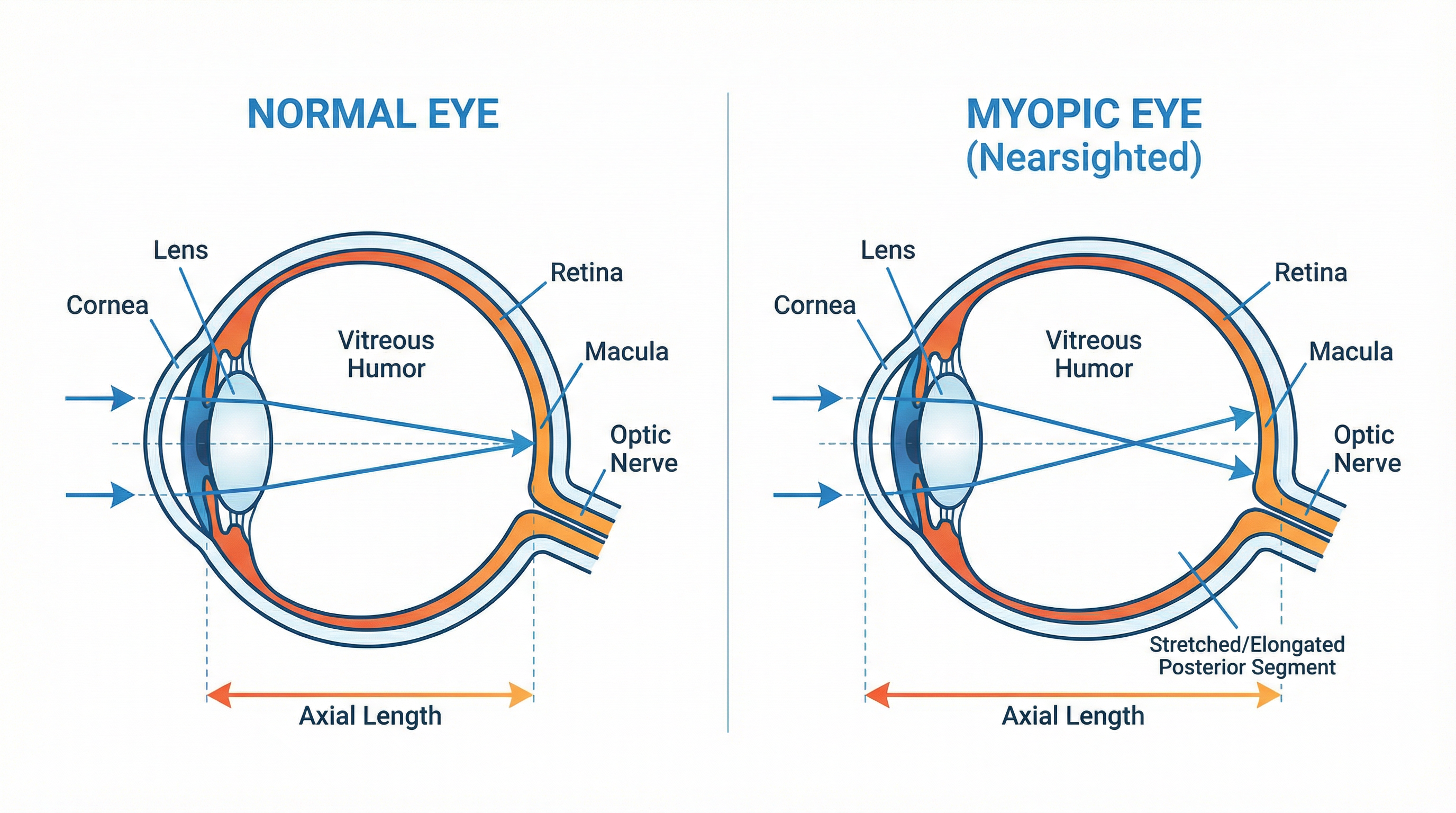
As myopia progresses, the eyeball keeps getting longer — a measurement called axial length. Each millimeter of additional axial length corresponds to roughly 3 diopters of myopia. So a child going from -1.00 to -4.00 diopters has had their eyeball grow by about 1 millimeter in the wrong direction.
That might not sound like much, but consider what's happening to the tissue inside. The retina, choroid, and sclera (the white outer coat of the eye) are all being stretched like a rubber band that's being pulled too tight. Over time, that mechanical stress causes real structural damage — and that's where things get serious.
What Happens to the Retina, Macula & Lens
The back of the eye is where vision actually happens. The retina is a thin layer of light-sensitive cells that lines the inside of the eyeball — think of it like the film in an old camera. The macula is the small central area of the retina responsible for sharp, detailed vision — reading, recognizing faces, driving. The choroid is the blood vessel layer that feeds the retina with oxygen and nutrients.
When the eyeball elongates, all of these layers get stretched. The choroid thins out, reducing blood flow to the retina. The retina itself can develop weak spots, tears, and eventually detach from the back of the eye — a medical emergency that can cause permanent blindness if not treated within hours. The macula can develop degenerative changes that permanently blur central vision, a condition called myopic macular degeneration.
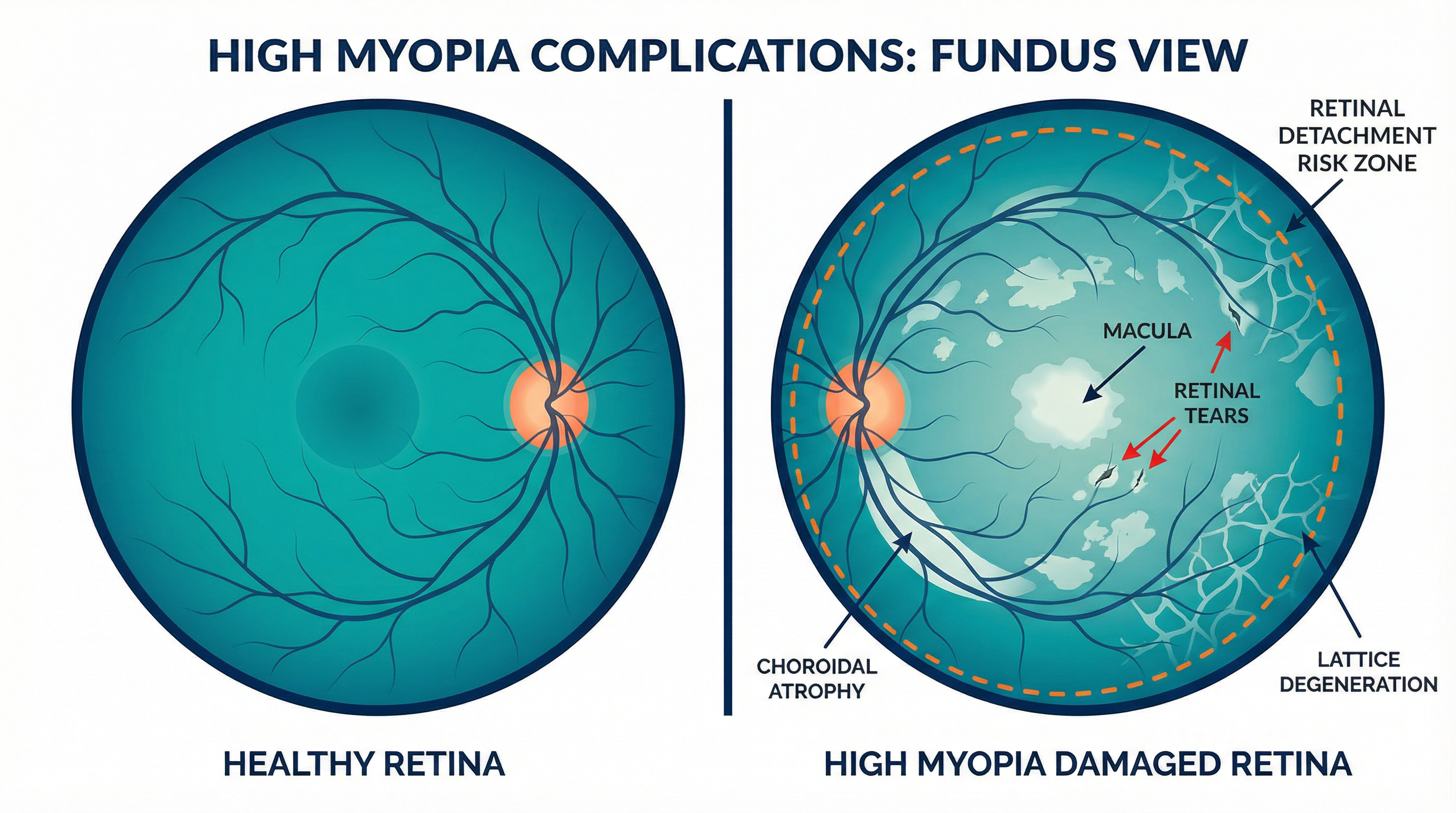
⚠ Important: These complications are not reversible. Glasses can correct blurry vision, but they cannot undo structural damage to the retina or macula. Prevention — through myopia control — is the only reliable strategy.
High myopia also increases the risk of glaucoma (damage to the optic nerve) and early cataracts. A 2024 review published in Progress in Retinal and Eye Research found that individuals with high myopia (above -6.00 D) face a 21-fold higher risk of retinal detachment and a 40-fold higher risk of myopic macular degeneration compared to people with no myopia. These aren't rare complications — they're predictable consequences of unchecked progression.
How Fast Does Myopia Progress? (By Age)
Myopia doesn't progress at the same rate throughout childhood. The fastest progression typically happens between ages 9 and 11 — right when kids are in elementary school and spending more time on screens and less time outdoors. Here's what the research shows about average annual progression rates:
Average Myopia Progression Rate by Age Group (Diopters/Year)
Source: Brien Holden Vision Institute; COMET Study data. Values represent average annual progression without treatment.
The takeaway here is clear: if your child is between 9 and 14 and their prescription is changing every year, they are in the highest-risk window. This is precisely when myopia control treatment has the greatest impact. Waiting until the prescription "stabilizes" is not a strategy — it's a gamble with your child's long-term vision.
What Makes Myopia Progress Faster?
Not every child with myopia progresses at the same rate. Several factors push progression faster — and understanding them helps parents take targeted action.
Age of Onset
Children who develop myopia before age 8 are 5× more likely to reach high myopia by adulthood. Earlier onset = more years of progression.
Family History
If both parents are myopic, a child has a 6× higher risk. If one parent is myopic, the risk is 3×. Genetics load the gun — environment pulls the trigger.
Screen Time
A 2025 JAMA Network Open meta-analysis confirmed that each additional hour of daily screen time increases myopia risk by 21%. Fort Liberty families with kids on devices all day, take note.
Lack of Outdoor Time
Bright outdoor light stimulates dopamine release in the retina, which slows axial elongation. Children who spend less than 90 minutes outdoors daily progress significantly faster.
Near Work
Extended reading, homework, and device use at close distances puts sustained focusing demand on the eye, which may accelerate elongation in susceptible children.
Ethnicity
East Asian children show the highest progression rates globally. However, myopia is rising rapidly across all ethnic groups in the U.S., including African American and Hispanic children.
Complications by Myopia Severity
The relationship between myopia severity and eye disease risk is not linear — it's exponential. Going from mild to high myopia doesn't just double the risk; it multiplies it dramatically. This table shows why keeping your child's prescription as low as possible is so important.
| Severity | Prescription Range | Retinal Risk | Glaucoma Risk | Detachment Risk |
|---|---|---|---|---|
| Mild | -0.25 to -3.00 D | Low | 1.5× baseline | 3× baseline |
| Moderate | -3.00 to -6.00 D | Moderate | 2× baseline | 9× baseline |
| High | -6.00 to -10.00 D | High | 3× baseline | 21× baseline |
| Extreme | Above -10.00 D | Very High | 4×+ baseline | 44× baseline |
Source: Flitcroft DI. The complex interactions of retinal, optical and environmental factors in myopia aetiology. Progress in Retinal and Eye Research, 2012. Risk multipliers are relative to emmetropia (no myopia).
Worried About Your Child's Myopia?
sleepSEE® is Cumberland County's only orthokeratology myopia control system — proven to slow progression by up to 60%. Your child wears lenses overnight and sees clearly all day, no glasses required.
What You Can Do to Slow Myopia Progression
The good news is that myopia progression is not inevitable. There are several evidence-based treatments that have been shown to meaningfully slow the rate at which a child's prescription worsens. The key is starting early — ideally as soon as myopia is detected in a child under 12.
Orthokeratology (Ortho-K) — sleepSEE®
Most EffectiveCustom-designed rigid lenses worn overnight that gently reshape the cornea while your child sleeps. They wake up and see clearly all day — no glasses, no daytime contacts. Multiple studies show Ortho-K reduces axial elongation by 45–60% compared to standard glasses. Eye Medics is Cumberland County's exclusive provider of sleepSEE®, the nation's fastest-growing Ortho-K system.
Learn about sleepSEE® →MiSight® Daily Contact Lenses
FDA-ApprovedThe first and only FDA-approved soft contact lens for myopia control in children. Worn during the day and discarded each night. Clinical trials show MiSight reduces myopia progression by an average of 59% over 3 years. A great option for children who are not yet candidates for Ortho-K.
Contact Lens Exams →Low-Dose Atropine Eye Drops
Adjunct TherapyA diluted form of atropine (0.01–0.05%) applied nightly has been shown to slow myopia progression by 50–60% with minimal side effects. Often used in combination with Ortho-K or MiSight for children with very fast progression.
Outdoor Time
Free & ProvenResearch consistently shows that children who spend at least 90 minutes per day outdoors in bright light have significantly slower myopia progression. Bright light triggers dopamine release in the retina, which inhibits axial elongation. This is the simplest, most accessible intervention — and it costs nothing.
A Note on Standard Glasses and Contacts
Regular single-vision glasses and standard contact lenses correct blurry vision — and that's important. But they have no effect on the underlying progression of myopia. In fact, some research suggests that certain types of single-vision lenses may slightly accelerate progression by creating peripheral defocus signals that encourage the eye to keep growing. If your child is in glasses and their prescription is changing every year, it's worth having a conversation about myopia control options.
Frequently Asked Questions
Trusted External Resources
Want to Learn More?
Dive Deeper Into the Science of Myopia Progression
For in-depth clinical research, risk factor guides, progression calculators, and the latest treatment data, visit MyopiaProgression.com — a dedicated resource for parents and eye care professionals who want to understand the full picture.
Explore MyopiaProgression.comReady to Take Action?
If your child's prescription has changed in the last year, it's time for a myopia control consultation. Eye Medics Optometry serves families across Fayetteville, Fort Liberty, Hope Mills, Spring Lake, and Raeford, NC.
sleepSEE® myopia control is a specialty service not covered by insurance. Flexible payment options and HSA/FSA funds are accepted.