
Better Vision, Better Grades
Beyond 20/20: The visual skills that drive academic success — and what happens when they're missing.
The Vision-Learning Connection
80% of Learning Is Visual — Is Your Child Getting the Full Picture?
Most school vision screenings only check for one thing: whether your child can read the 20/20 line on a chart. But there are 17 distinct visual skills required for effective reading, writing, and learning — and a school screening tests for fewer than 3 of them.
A child can pass a school screening and still have a significant vision problem that’s affecting their grades, attention span, and confidence. The frustrating part? They often don’t know their vision is the problem — they just think they’re “bad at reading.”
1 in 4
school-age children has a vision problem affecting learning
80%
of learning in the first 12 years is visual
1 in 4
children has a vision problem affecting school
17
visual skills needed for effective learning
3
skills tested in a typical school screening
For Parents
Does Your Child Show These Warning Signs?
Many vision problems that affect learning don’t have obvious symptoms. Children often don’t complain because they assume everyone sees the way they do. Watch for these behaviors.
Loses place while reading
Frequently skips lines or uses a finger to track words on the page.
Avoids close work
Shows reluctance to read, do homework, or engage in near-vision tasks.
Holds material too close
Brings books or tablets unusually close to their face to see clearly.
Headaches or eye strain
Complains of headaches or tired eyes, especially after school or reading.
Tilts head or covers one eye
Compensating for a vision problem like amblyopia or strabismus.
Poor reading comprehension
Struggles to remember or understand what was just read, despite effort.
If you noticed 2 or more of these signs, a comprehensive eye exam is recommended.
Schedule a Pediatric Eye ExamIf you noticed 2 or more of these signs, a comprehensive eye exam is recommended.
While you wait for your appointment, our free parent guide explains exactly what to look for, what to ask your doctor, and how to advocate for your child’s vision health.
Better Vision, Better Grades
Be the first to get our free parent guide — understand the science behind your child’s vision and know exactly what to ask your doctor.
- The 17 visual skills a school screening never tests
- 20+ warning signs checklist by age group
- What to ask your eye doctor — and when to act
Join 59 parents on the waitlist
 FREE — No Credit Card
Beyond 20/20
The Visual Skills That Drive Learning
A comprehensive eye exam at Eye Medics tests all of these — not just the ones a school screening covers.
Visual Acuity
Seeing clearly at distance and near — what most school screenings test for.
Eye Teaming
Both eyes working together as a coordinated team for depth perception and reading.
Eye Tracking
Smoothly following a line of text without losing place or skipping words.
Eye Focusing
Quickly and accurately shifting focus between near and far objects.
Visual Memory
Storing and recalling visual information — critical for spelling and math.
Visual Processing
Interpreting and making sense of what the eyes see — the brain-eye connection.
School screenings test for: Visual acuity only (the 20/20 line).|Our comprehensive exam tests: All 17 visual skills.
What a Comprehensive Pediatric Eye Exam Includes
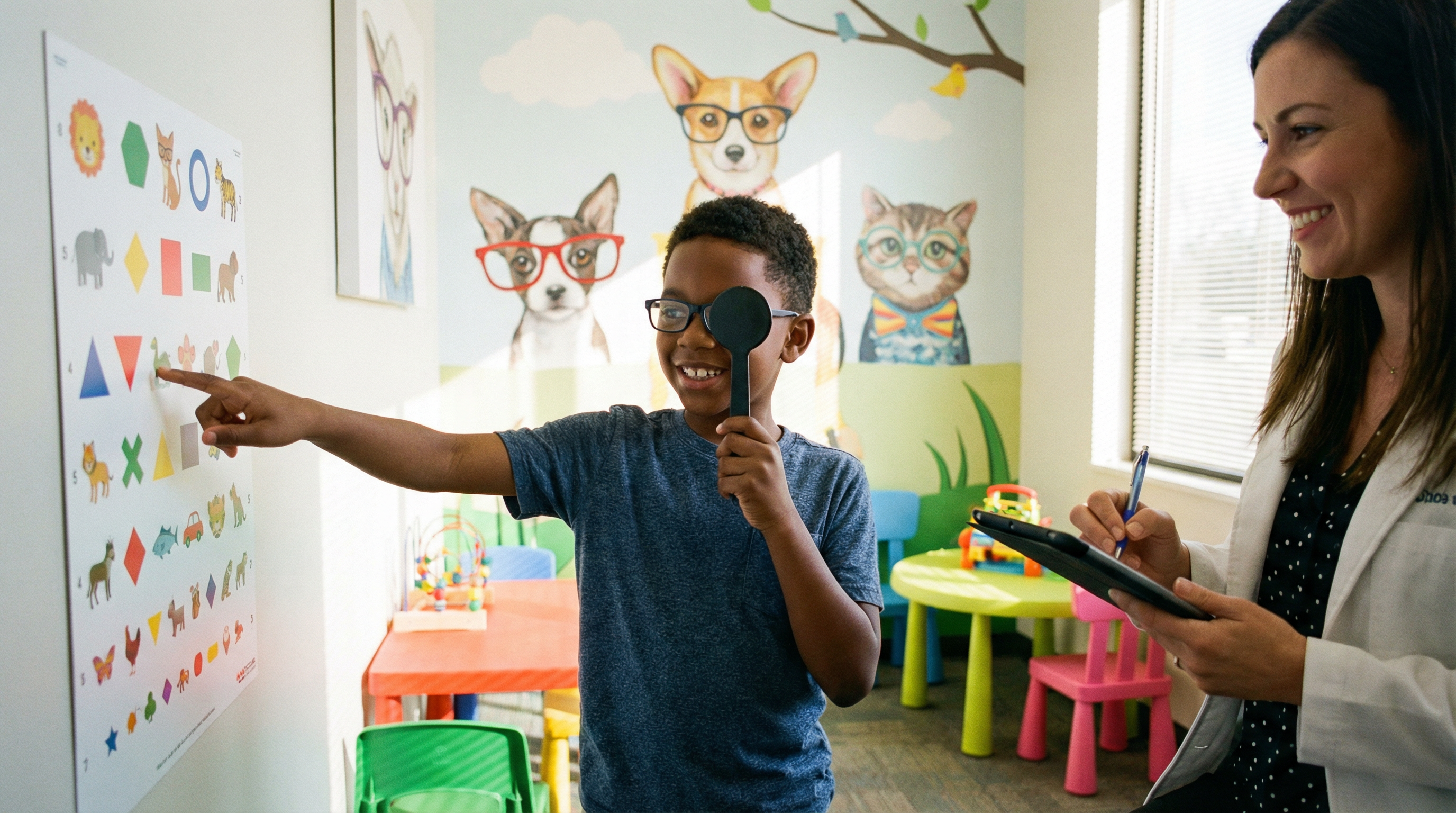
At Eye Medics, a pediatric eye exam goes far beyond reading the chart. We test every visual skill that impacts learning, sports performance, and daily life.
Last reviewed: February 2026 by Dr. James H. Singletary, OD, FIAOMC
Medical Disclaimer
This page is for informational purposes only and does not constitute medical advice, diagnosis, or treatment. The information provided here should not be used as a substitute for professional medical advice from a qualified eye care provider. Always consult with a licensed optometrist or ophthalmologist regarding any eye health concerns, symptoms, or treatment decisions.
Ready to Schedule Your Visit?
Our team is here to help you and your family see clearly. Book your appointment today.
