
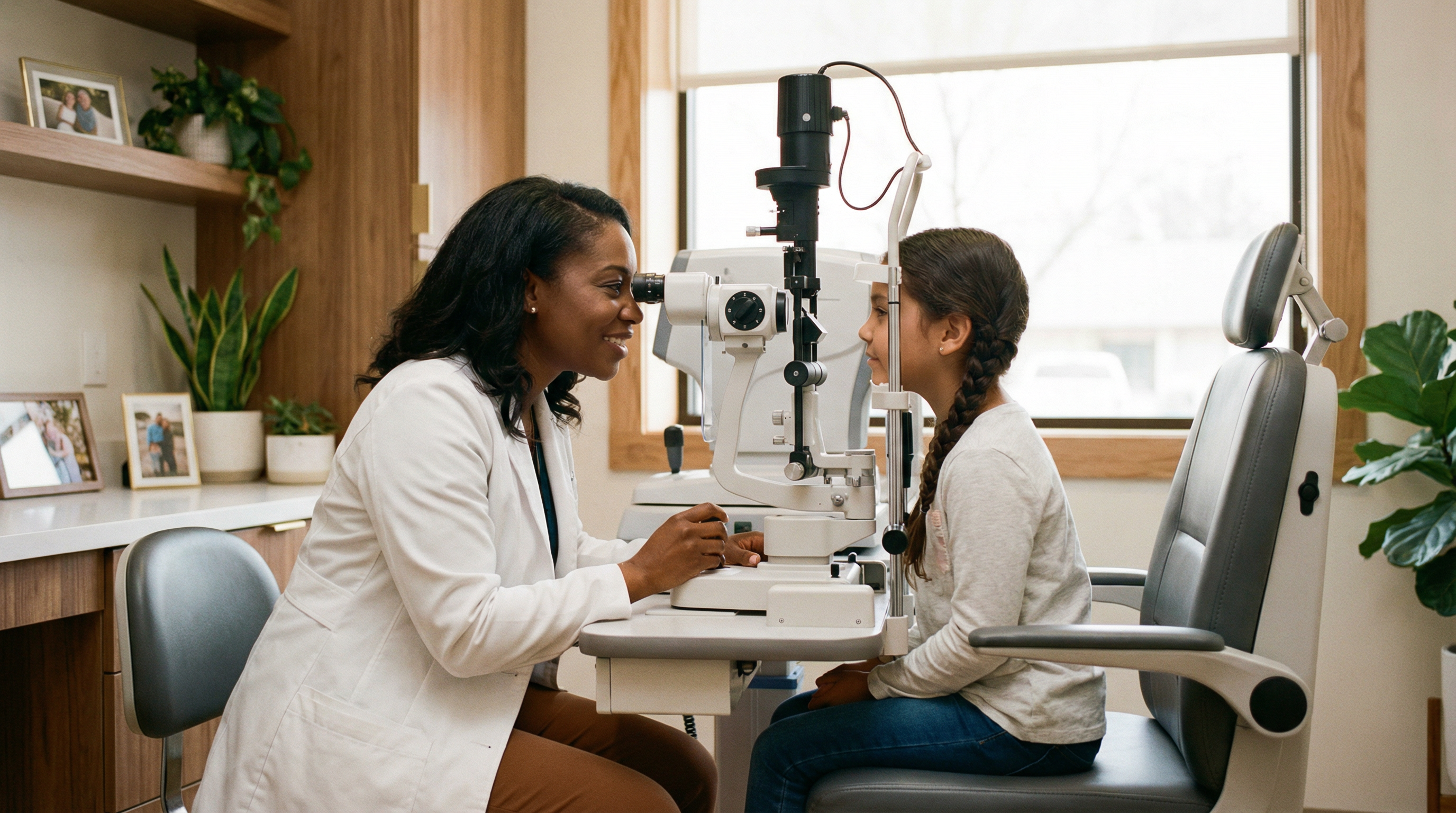
Quick Answer: When Should a Child Have Their First Eye Exam?
The American Optometric Association recommends a child's first comprehensive eye exam at 6 months of age, again at age 3, and before starting kindergarten. After that, annual exams are recommended through the school years. Early detection is the single most important factor in successful treatment of childhood vision problems.
Here's something that surprises a lot of parents: a child can have a significant vision problem and have no idea. Kids don't know what "normal" vision looks like — they've never seen through anyone else's eyes. So when a child is struggling to read, avoiding homework, or getting headaches after school, the last thing most parents think to check is their vision.
At Eye Medics Optometry in Fayetteville, NC, we see this all the time. A parent brings in a child who's been labeled as "not trying hard enough" in school — and it turns out they've been trying to read through blurry vision for two years. A proper pediatric eye exam changes everything. We serve families throughout Cumberland County, including Hope Mills, Spring Lake, Raeford, and the Fort Liberty community.
When Should My Child Have Their First Eye Exam?
Most parents wait until their child starts school — or until a teacher flags a problem. By then, a lot of time has been lost. The visual system develops rapidly in the first few years of life, and certain conditions like amblyopia (lazy eye) are much easier to treat before age 7 than after.
The American Optometric Association recommends:
- First exam at 6 months — yes, babies can and should have their eyes checked
- Second exam at age 3
- Third exam before starting kindergarten (age 5–6)
- Annual exams every year through high school
I know the idea of bringing in a 6-month-old for an eye exam sounds strange. But we do it all the time, and it's completely comfortable for the baby. We don't need them to read letters — we use specialized techniques that work beautifully even with infants who can't yet talk.
Why School Vision Screenings Aren't Enough
Every year, thousands of kids in Cumberland County schools pass their vision screening and go home with a clean bill of health — even though they have real vision problems. Here's why that happens.
School screenings typically only check one thing: whether a child can read a chart 20 feet away. That's it. They don't check near vision (critical for reading), eye teaming (how well the two eyes work together), focusing ability, or early signs of amblyopia. A child can have significant farsightedness, convergence insufficiency, or a lazy eye — and still pass the school screening.
Research finding: School vision screenings miss up to 75% of vision problems that a comprehensive eye exam would detect. A "pass" on a school screening is not the same as a healthy eye exam.
A comprehensive pediatric eye exam at our Fayetteville office takes about 45 to 60 minutes and checks everything — not just distance acuity, but near vision, eye alignment, color vision, depth perception, eye health, and more.
What We Actually Check at a Kids' Eye Exam
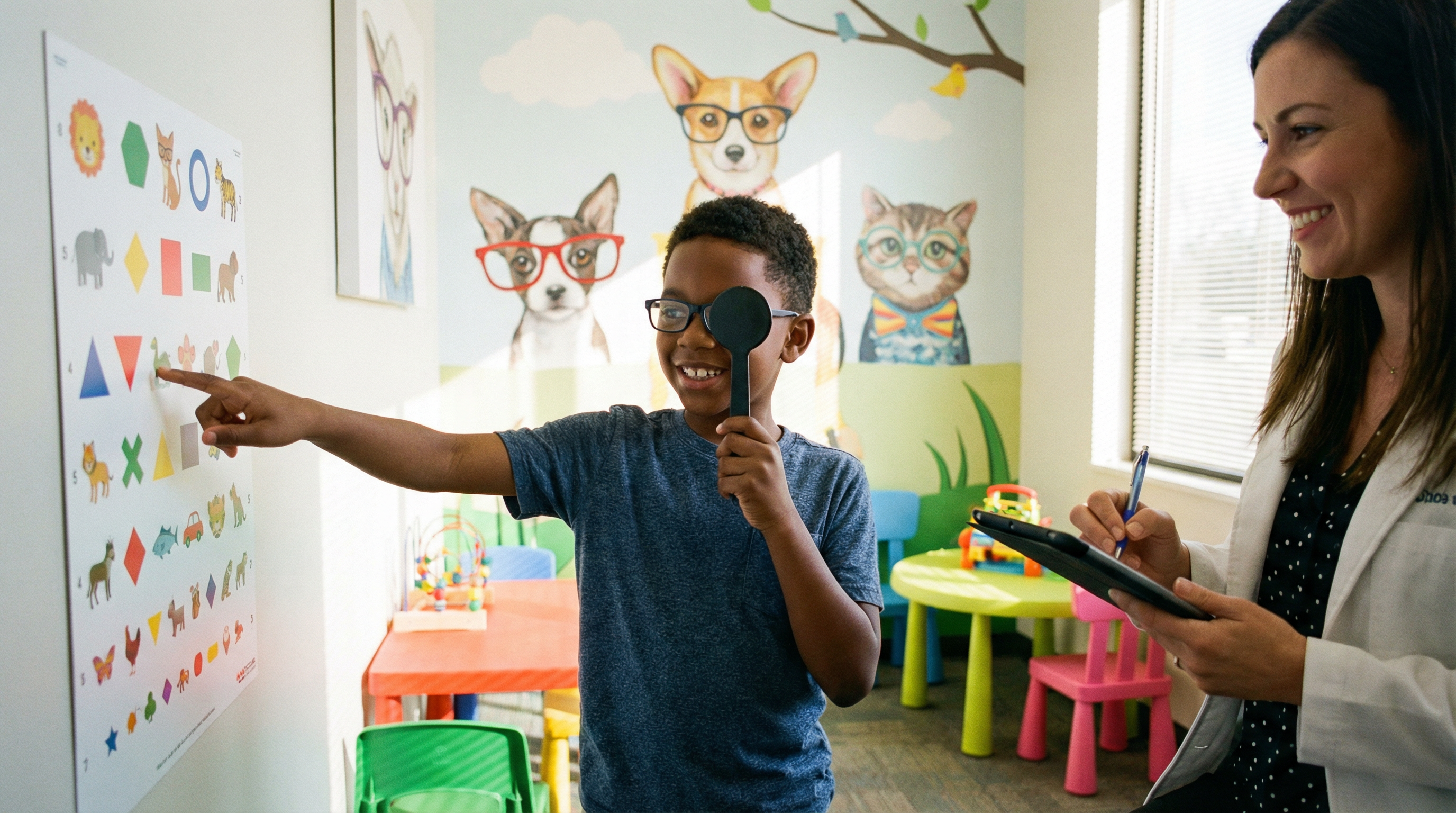
A pediatric eye exam at Eye Medics is thorough but kid-friendly. We use colorful charts, fun games, and instruments designed specifically for children. Here's what we evaluate:
Visual Acuity
How clearly your child sees at distance and up close — the foundation of everything.
Refractive Error
Whether your child is nearsighted, farsighted, or has astigmatism — and if so, how much.
Eye Alignment
Whether the eyes point in the same direction. Misalignment (strabismus) can lead to amblyopia if untreated.
Eye Teaming (Binocularity)
Whether both eyes work together as a team. Poor teaming causes double vision, headaches, and reading problems.
Focusing Ability
Whether your child can quickly shift focus from near to far — essential for classroom learning.
Eye Health
A slit-lamp exam of the front of the eye and a dilated view of the retina, optic nerve, and blood vessels.
Color Vision
Color deficiency affects about 8% of boys and 0.5% of girls — and most don't know they have it.
Myopia Risk Assessment
We identify children at high risk for progressive nearsightedness early, when myopia control is most effective.
Warning Signs Parents Often Miss
Some signs of vision problems in children are obvious. Many are not. Here's what to watch for — especially during the school year:
Squinting or closing one eye to see
Holding books or devices very close to the face
Frequent headaches, especially after reading
Losing their place while reading or skipping lines
Avoiding reading, drawing, or close work
Tilting the head or covering one eye
Rubbing eyes frequently
Complaints that words 'move' or 'blur' on the page
Short attention span for near tasks
Eyes that appear crossed or don't move together
If your child shows any of these signs — or if you just have a gut feeling something's off — trust that instinct. Schedule an exam. The cost of missing a vision problem is far higher than the cost of checking.
Recommended Exam Schedule by Age
Here's a simple reference guide for when to bring your child in, and why each milestone matters:
| Age / Stage | Why It Matters | How Often |
|---|---|---|
| 6 Months | First baseline exam. Checks for refractive errors, eye alignment, and early amblyopia risk. | Once |
| Age 3 | Preschool vision check. Detects lazy eye, crossed eyes, and significant prescription changes before school. | Once |
| Age 5–6 | Pre-kindergarten exam. Critical before reading begins — undetected vision problems directly hurt literacy. | Once |
| Ages 6–17 | Annual exams through school years. Myopia often starts around age 8–10 and progresses quickly. | Every Year |
| High Risk Children | Family history of amblyopia, strabismus, or high myopia. Premature birth. Developmental delays. | As directed |
Source: American Optometric Association InfantSEE® program guidelines
How Vision Problems Affect Learning
This is the part that hits parents hardest when they finally find out. Vision is the foundation of learning — and when it's compromised, everything else suffers. Reading, writing, math, attention, confidence. All of it.
Vision and Learning — By the Numbers
Sources: American Optometric Association, College of Optometrists in Vision Development
I've had parents come in with kids who've been in reading intervention programs for a year — and all they needed was glasses. Once they could see clearly, they caught up quickly. The brain is remarkably adaptable when it finally gets the right input.
If your child is struggling in school and you haven't had a comprehensive eye exam in the past year, that's the first place to start. Not tutoring. Not medication. An eye exam. It takes less than an hour and can change the trajectory of a child's education.
Insurance and TRICARE Coverage
We proudly serve military families at Fort Liberty and throughout Cumberland County. We accept TRICARE Prime and TRICARE Select for pediatric eye exams, and we are in-network with most major vision and medical insurance plans.
TRICARE Prime & Select
VSP Vision Care
EyeMed
Blue Cross Blue Shield
Medicaid / NC Health Choice
Aetna, Cigna, United
Not sure if your plan is covered? Call us at 910.426.3937 or mention your insurance when you book online — our team will verify your benefits before your appointment.
Frequently Asked Questions
Last reviewed: February 2026 by Dr. James H. Singletary, OD, FIAOMC
Schedule Your Child's Eye Exam Today
Serving Fayetteville, Hope Mills, Spring Lake, Raeford, and Fort Liberty. We see patients of all ages — including infants. Same-week appointments often available.
Book a Pediatric Eye Exam