
Quick Answer: What Is Amblyopia?
Amblyopia (lazy eye) is a childhood vision condition where one eye doesn't develop normal visual sharpness — not because of a problem with the eye itself, but because the brain learns to favor the other eye. It affects roughly 2–3% of children and is the leading cause of vision loss in one eye among kids and young adults. Treatment is most effective before age 7, but can help older children too.
"Lazy eye" is one of those terms that gets thrown around a lot — but most parents don't fully understand what it means until their child is diagnosed with it. The name is a little misleading, honestly. The eye isn't lazy. The brain is. It's learned to tune out the signals from one eye, usually because those signals were blurry, misaligned, or blocked during a critical window of visual development.
At Eye Medics Optometry in Fayetteville, NC, we diagnose and treat amblyopia in children of all ages. The earlier we catch it, the better the outcome — which is one of the main reasons we recommend comprehensive eye exams starting at 6 months. We serve families throughout Cumberland County, including Hope Mills, Spring Lake, Raeford, and Fort Liberty.
What Is Amblyopia (Lazy Eye)?
During the first several years of life, the brain and eyes are still learning to work together. Vision is essentially a skill — and like any skill, it develops through practice. When one eye consistently sends a clearer, better signal than the other, the brain starts to rely on the stronger eye and gradually suppresses the input from the weaker one.
Over time, the neural pathways between the weaker eye and the brain become underdeveloped. Even if you put a perfect lens in front of that eye, the brain still can't process the image clearly — because it never learned how. That's amblyopia.
According to the National Eye Institute, amblyopia affects approximately 2 to 3 percent of the U.S. population — making it the most common cause of vision impairment in one eye among children and young adults. The good news is that it's very treatable, especially when caught early.
What Causes It?
There are several different types of amblyopia, each with a different underlying cause. Understanding the type matters because it affects the treatment approach.
| Type | Cause | Visibly Obvious? | Notes |
|---|---|---|---|
| Strabismic Amblyopia | Eye turn (strabismus) — one eye points in a different direction | Yes — eye may appear crossed or wandering | Most recognized type |
| Refractive Amblyopia | Large difference in prescription between the two eyes (anisometropia) | No — eyes look perfectly normal | Most common type overall |
| Deprivation Amblyopia | Something blocks vision in one eye (cataract, droopy eyelid, etc.) | Sometimes — depends on the cause | Least common but most severe |
| Bilateral Amblyopia | Both eyes have high, uncorrected refractive error | No | Less common; often missed |
Source: American Academy of Ophthalmology, National Eye Institute
The most important thing to know: the most common form of amblyopia — refractive amblyopia — produces no visible symptoms. The eyes look straight. The child doesn't complain. The only way to catch it is through a comprehensive eye exam that includes a dilated refraction.
How to Tell If Your Child Has It
Because amblyopia often has no obvious symptoms, many parents are caught off guard by the diagnosis. But there are some signs worth watching for:
One eye appears to turn in or out
Strabismus (eye turn) is a common cause of amblyopia and is usually visible.
Squinting or closing one eye
A child may close the weaker eye to see more clearly with the stronger one.
Head tilting
Tilting the head is a way of compensating for poor alignment or unequal vision.
Poor depth perception
Difficulty judging distances, catching balls, or navigating stairs.
Covering one eye
Some children intuitively cover the weaker eye when trying to focus.
No symptoms at all
Refractive amblyopia often has zero visible signs — which is why regular exams matter.
Important: Children with amblyopia often don't know their vision is abnormal — they've never experienced anything different. Don't wait for your child to complain. Regular eye exams are the only reliable way to detect it.
How We Diagnose Amblyopia
Diagnosing amblyopia requires a comprehensive eye exam — not just a vision screening. At Eye Medics, our pediatric exam includes a cycloplegic refraction (we use dilating drops to relax the focusing muscles and get the most accurate prescription), visual acuity testing in each eye separately, and a thorough evaluation of eye alignment and binocular vision.
We also use a technique called cover testing to check for subtle eye turns that might not be obvious to the naked eye. And for children with suspected strabismus, we evaluate the full range of eye movements to understand exactly what's happening.
The diagnosis is confirmed when one eye tests significantly worse than the other — even with the best possible correction in place. That gap in acuity, combined with the clinical findings, tells us we're dealing with amblyopia rather than just a prescription difference.
Treatment Options
The goal of amblyopia treatment is to force the brain to use the weaker eye — which, over time, strengthens the neural connections and improves vision. There are several ways to accomplish this:
Corrective Glasses or Contact Lenses
For many children, especially those with refractive amblyopia, simply wearing the correct prescription is the first and most important step. In mild cases, glasses alone can resolve amblyopia over time. We always start here before adding other treatments.
Eye Patching
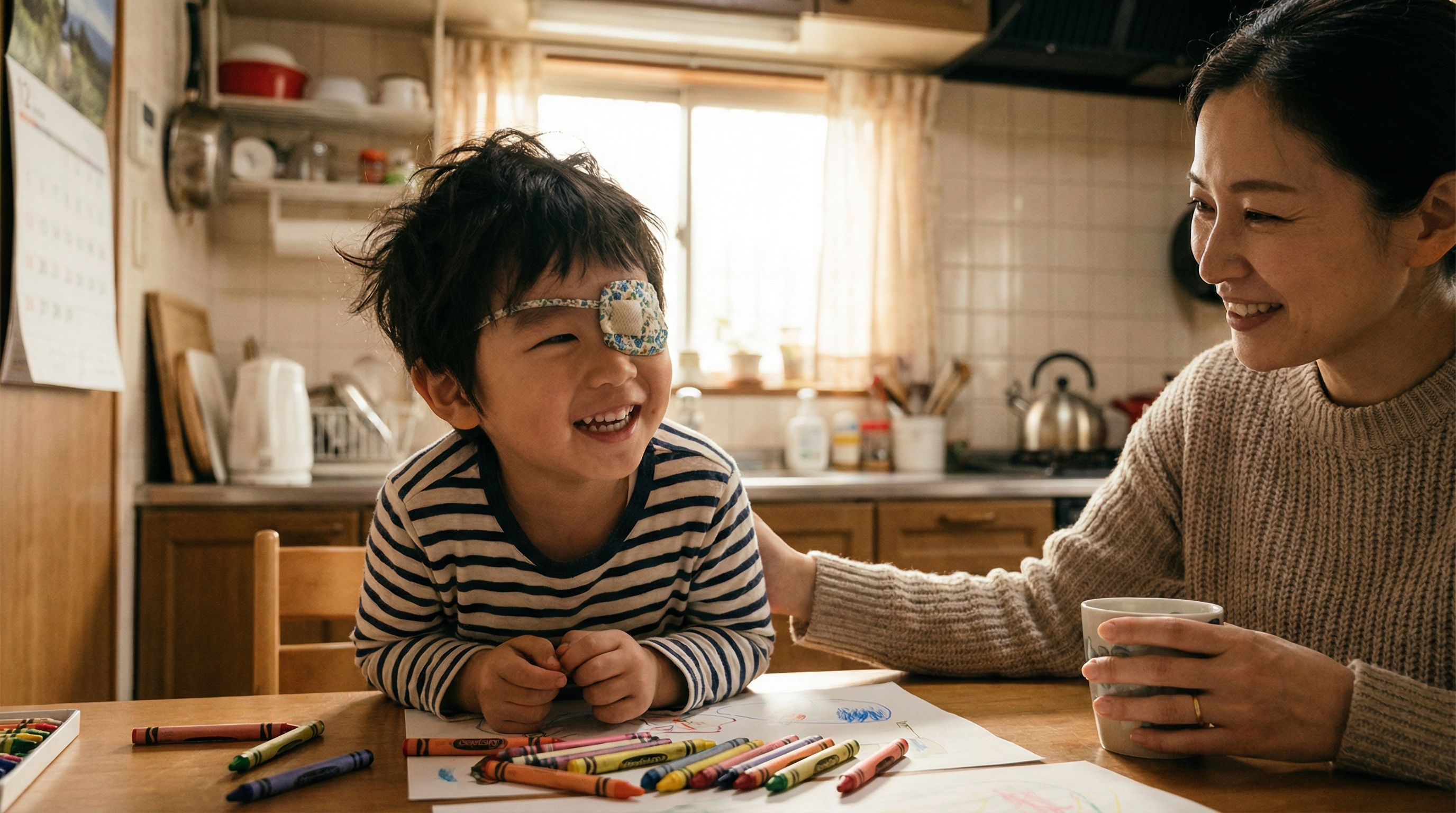
Patching the stronger eye for a prescribed number of hours per day is one of the most proven treatments for amblyopia. It forces the brain to rely on the weaker eye, stimulating development. Compliance is the biggest challenge — kids don't love wearing a patch. We work with families to make it as manageable as possible.
Atropine Eye Drops
Atropine drops are placed in the stronger eye to temporarily blur its vision, achieving a similar effect to patching without the physical patch. Many families find this easier to manage, especially for younger children. Research shows it's equally effective for moderate amblyopia.
Vision Therapy
For some children, particularly those with binocular vision problems underlying their amblyopia, vision therapy — a structured program of eye exercises — can be an effective complement to other treatments. We'll discuss whether this is appropriate for your child.
Why Age Matters So Much
The visual system is most adaptable — most "plastic," in neuroscience terms — during the first seven years of life. During this window, the brain is actively building and strengthening the neural pathways that process vision. After this critical period closes, those pathways become much harder to change.
This doesn't mean treatment is hopeless after age 7. Research from the Pediatric Eye Disease Investigator Group (PEDIG) has shown meaningful improvement in children up to age 17 with consistent treatment. But the results are generally better, faster, and more complete when treatment starts early.
Amblyopia Treatment Success Rates by Age
Approximate likelihood of achieving significant visual improvement with consistent treatment. (Sources: Pediatric Eye Disease Investigator Group, NEI)
Treatment success decreases significantly after age 7 — the critical window for visual development.
The chart above illustrates why we push so hard for early eye exams. A child diagnosed at age 3 and treated promptly has an excellent chance of achieving normal vision. The same child diagnosed at age 10 faces a much harder road — not impossible, but harder.
What to Expect: Treatment Outcomes
Most children with amblyopia who receive consistent, appropriate treatment will see significant improvement. "Significant" means different things depending on the severity — some children achieve 20/20 vision in the amblyopic eye; others may reach 20/40 or 20/50, which is still a dramatic improvement over untreated amblyopia.
Treatment is rarely a straight line. There are good weeks and frustrating weeks. Compliance with patching or drops is the single biggest predictor of success — and that's often the hardest part. We work closely with families to troubleshoot compliance issues and adjust the treatment plan as needed.
After active treatment ends, we continue to monitor the child's vision periodically — typically until age 10 to 12 — to watch for any regression. If vision starts to slip, we can restart treatment promptly. The goal is to get the best possible vision and keep it there for life.
Frequently Asked Questions
Last reviewed: February 2026 by Dr. James H. Singletary, OD, FIAOMC
Concerned About Your Child's Vision?
Early detection is everything with amblyopia. If your child hasn't had a comprehensive eye exam recently — or if you've noticed any of the warning signs above — don't wait. We see patients of all ages, including infants.
Schedule an Exam