
Hard-to-Fit Contact Lenses
Been told you can't wear contacts? Let's find out what's actually possible.
What Does "Hard to Fit" Actually Mean?
"Hard to fit" is one of those phrases that sounds like a dead end. It's not. It just means your eyes have characteristics that make standard soft contact lenses a poor match — either they can't correct your vision well enough, they don't sit properly on your eye, or they're too uncomfortable to wear for any meaningful amount of time.
I hear this a lot from new patients at my practice in Fayetteville. Someone tried soft contacts years ago, couldn't get them to work, and was told to just stick with glasses. Or they've been through five or six different brands and still can't see clearly. Or their dry eye is so bad that contacts feel like sandpaper after two hours.
Here's the thing — "hard to fit" doesn't mean "impossible to fit." It means you need someone with the right equipment and experience in specialty lens fitting. That's what we do here.
Conditions That Make Fitting Harder
There are specific eye conditions that make standard soft contacts a poor fit. Most of them are more common than people realize.
Keratoconus
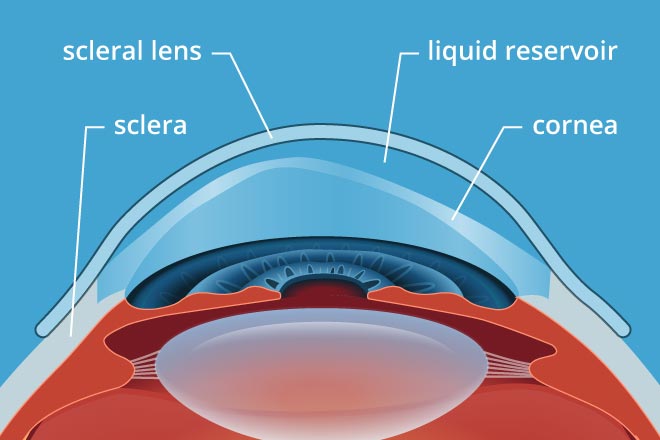
The cornea bulges into a cone shape. Soft lenses drape over the irregularity and can't create a clear image. Scleral lenses vault over the cornea entirely.
Severe Dry Eye
Standard soft lenses absorb moisture from the eye surface. For patients with dry eye disease, this makes lens wear painful within hours. Scleral lenses do the opposite — they add moisture.
Post-LASIK or Post-Surgical Corneas
LASIK, PRK, and corneal transplants change the shape of the cornea. Standard lenses often don't fit properly on a surgically altered surface.
Irregular Astigmatism
Regular astigmatism can be corrected with toric soft lenses. Irregular astigmatism — where the cornea is warped in an unpredictable pattern — usually can't be corrected with soft lenses at all.
High Myopia or Hyperopia
Very high prescriptions push the limits of what soft lenses can reliably correct. Rigid gas-permeable lenses often provide sharper vision at the extremes.
Giant Papillary Conjunctivitis (GPC)
An allergic reaction to contact lens wear that causes bumps on the inner eyelid. Switching lens material or type often resolves the problem.
A lot of patients in Cumberland County come to me after being bounced around between providers. They've been told they're "not a candidate" for contacts, but nobody actually explained why — or what the alternatives are. That's where we come in.
Why Standard Contacts Fail for These Patients
Standard soft contact lenses are designed for normal, healthy corneas with mild to moderate prescriptions. They're flexible, they drape over the eye, and they work great for the majority of contact lens wearers.
The problem is that "draping over the eye" is exactly what causes the failure for hard-to-fit patients. If your cornea is irregular — whether from keratoconus, surgery, or trauma — a soft lens just follows that irregular shape. It can't create a smooth optical surface. The result is blurry, distorted vision even with the lens in.
For dry eye patients, the problem is different. Soft lenses are essentially sponges. They absorb moisture from the tear film, which is already depleted in dry eye patients. By mid-afternoon, the lens is drying out, the eye is irritated, and vision gets hazy. No amount of rewetting drops fully solves this.
Your Specialty Lens Options
There are four main types of specialty lenses we use at Eye Medics. The right one depends on your specific condition, your prescription, and your lifestyle.
Scleral Lenses
Most VersatileLarge-diameter rigid lenses (16–22mm) that vault completely over the cornea and rest on the white of the eye. The space between the lens and cornea fills with saline, creating a smooth optical surface regardless of corneal shape. Our most-used tool for keratoconus, dry eye, and post-surgical corneas.
Rigid Gas Permeable (RGP) Lenses
Best for Mild-Moderate CasesSmaller rigid lenses (9–10mm) that rest on the cornea. They hold their shape over irregular surfaces and provide sharper vision than soft lenses for many patients. Longer adaptation period than soft lenses, but a solid option for mild to moderate keratoconus and high astigmatism.
Hybrid Lenses
Best of Both WorldsA rigid gas-permeable center with a soft outer skirt. You get the optical clarity of a rigid lens with the comfort of a soft lens. Good middle ground for patients who need better vision than soft lenses provide but struggle with the adaptation period of RGP lenses.
Orthokeratology (Ortho-K)
Best for Myopia ControlRigid lenses worn overnight that gently reshape the cornea. When removed in the morning, you can see clearly all day without any lenses. Primarily used for myopia control in children and teens, and for adults who want daytime freedom from correction.
Not sure which one applies to you? That's what the evaluation is for. We'll map your corneas, review your history, and recommend the lens type that makes the most sense for your eyes and your life. Learn more on our Specialty Contact Lenses page.
Comparing Your Options
Here's a quick side-by-side to help you understand where each lens type fits.
| Lens Type | Best Conditions | Comfort | Typical Cost |
|---|---|---|---|
| Scleral | Keratoconus, dry eye, post-surgical | Excellent | $1,500–$3,500 |
| RGP | Mild keratoconus, high astigmatism | Moderate (adaptation needed) | $500–$1,500 |
| Hybrid | Mild-moderate keratoconus, irregular astigmatism | Good | $800–$2,000 |
| Ortho-K | Myopia (esp. children), adults wanting daytime freedom | Worn overnight only | $1,200–$2,500 |
| Standard Soft | Normal corneas, mild-moderate Rx | Excellent | $200–$600/yr |
* Costs are estimates and vary based on lens complexity, number of fitting visits, and insurance coverage. We'll provide a detailed quote at your evaluation.
What to Expect at Your Fitting
A specialty lens fitting is more involved than a standard contact lens exam. Here's what the process looks like at Eye Medics.
Comprehensive Eye Exam
We start with a full exam to assess your vision, eye health, and any underlying conditions. If you haven't had a recent exam, we'll do one at the same visit.
Corneal Topography Mapping
We use a corneal topographer to create a detailed 3D map of your cornea's surface. This is essential for fitting scleral, RGP, and hybrid lenses accurately.
Trial Lens Fitting
Based on your measurements, we select trial lenses and have you try them in-office. We assess the fit, check your vision, and make adjustments.
Lens Ordering & Delivery
Once we have a good fit, we order your custom lenses. Most specialty lenses take 1–2 weeks to arrive.
Dispensing & Training
When your lenses arrive, you come in for a dispensing visit. We teach you how to insert, remove, and care for your lenses — it's different from standard soft lenses and takes a little practice.
Follow-Up Visits
We schedule follow-up visits to make sure the lenses are fitting well and your vision is stable. Most patients are fully dialed in within 4–6 weeks.
Insurance & TRICARE Coverage
Specialty contact lens fittings are often covered — at least partially — when there's a documented medical necessity. Conditions like keratoconus, post-surgical corneas, and severe dry eye typically qualify.
| Insurance Type | Typical Coverage | Notes |
|---|---|---|
| TRICARE Prime / Select | Medically necessary specialty lenses | Requires documented diagnosis (e.g., keratoconus). We verify before starting. |
| TRICARE For Life | Varies — often covers fitting fees | Secondary to Medicare. Call us to verify your specific plan. |
| Blue Cross Blue Shield | Fitting fees often covered under medical benefit | Separate from vision benefit. Medical necessity required. |
| VSP / EyeMed | Limited — vision plans rarely cover specialty lenses | May cover part of the lens cost. Medical plan often covers the rest. |
| Medicaid (NC) | Covered for keratoconus and select conditions | Prior authorization usually required. |
We serve a lot of active duty service members and veterans from Fort Liberty and the surrounding area. Our team will verify your TRICARE benefits before your appointment so you know exactly what to expect. No surprises.
Frequently Asked Questions
Related Services at Eye Medics
References
- 1. Barnett M, et al. "Contemporary Scleral Lenses: Theory and Application." Cont Lens Anterior Eye. 2019;42(5):465–466.
- 2. Sindt CW, Longmuir RA. "Contact lens strategies for the patient with dry eye." Ocul Surf. 2007;5(4):294–307.
- 3. American Optometric Association — Types of Contact Lenses
- 4. U.S. Food & Drug Administration — Types of Contact Lenses
Last reviewed: March 2026
Medical Disclaimer
This page is for informational purposes only and does not constitute medical advice, diagnosis, or treatment. The information provided here should not be used as a substitute for professional medical advice from a qualified eye care provider. Always consult with a licensed optometrist or ophthalmologist regarding any eye health concerns, symptoms, or treatment decisions.
Think You're Hard to Fit? Let's Find Out.
Most patients who've been told they can't wear contacts can wear specialty lenses. Schedule a specialty lens evaluation at Eye Medics in Fayetteville — we serve patients from Fort Liberty, Hope Mills, and all of Cumberland County.
