
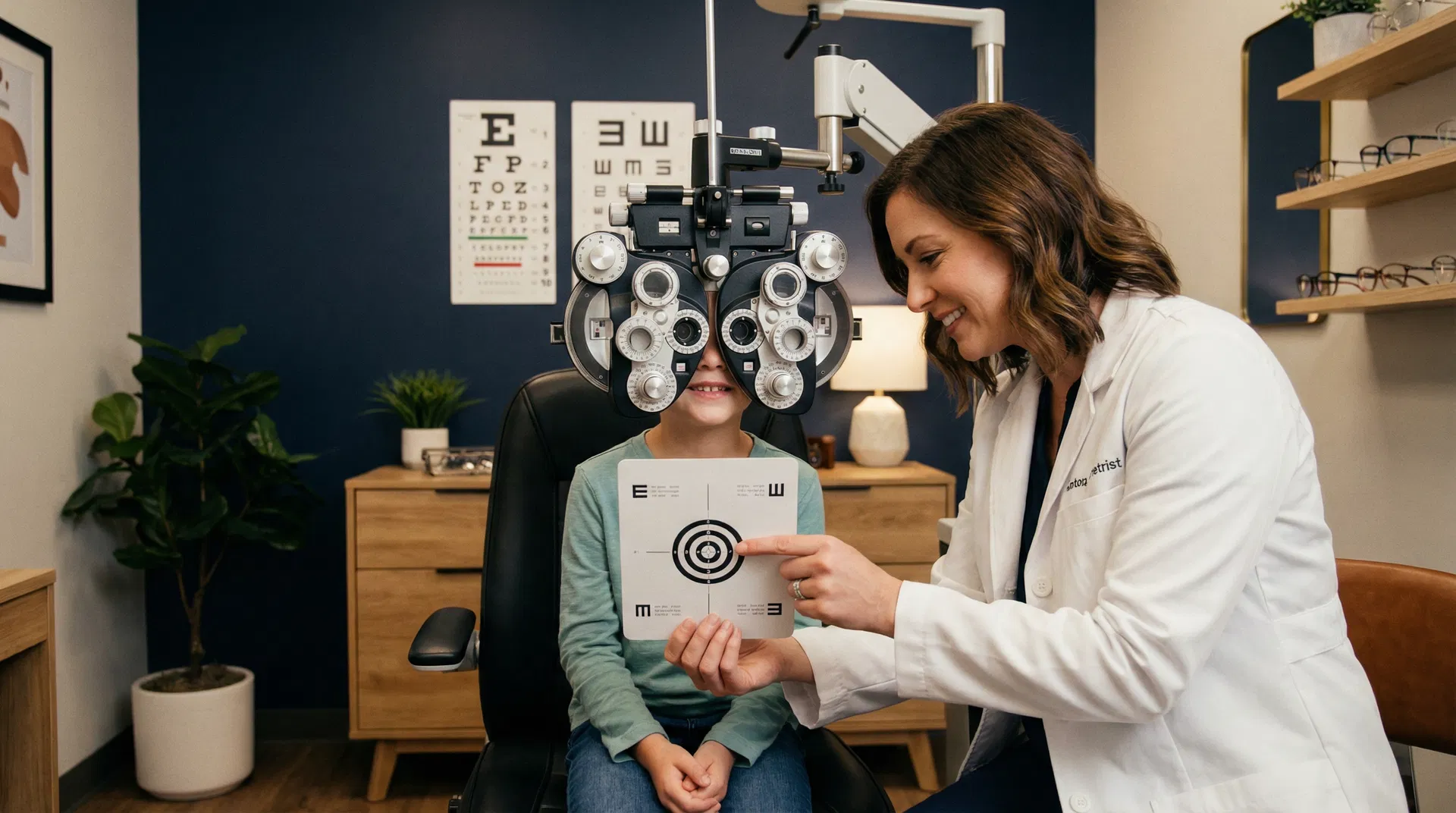
Here's the thing most parents don't realize: a standard eye chart test — the one where you read letters from across the room — tells us almost nothing about how your child's eyes work together. It doesn't measure how the eyes team up, how they track across a line of text, or how the brain makes sense of what the eyes see. And those are exactly the skills your child needs to read, learn, and compete.
A Visual Analysis exam is a deeper look. At Eye Medics Optometry in Fayetteville, NC, we use it to evaluate three interconnected systems: binocular vision (how the two eyes coordinate), visual processing (how the brain interprets visual information), and performance vision (how the visual system holds up under the demands of sports or high-concentration tasks). When any one of these systems breaks down, the effects show up in ways that look a lot like ADHD, dyslexia, or just "not trying hard enough" — and that misdiagnosis happens more than you'd think.
We see this constantly with families from Fort Liberty, Cumberland County schools, and the surrounding Fayetteville community. A child comes in because his teacher says he can't focus. His distance vision is 20/20. His parents are frustrated. But when we run a full binocular vision workup, we find convergence insufficiency — his eyes literally can't hold together at reading distance. That's not an attention problem. That's a vision problem. And it's treatable.
Binocular Vision
How the two eyes work together
Convergence insufficiency, eye teaming, depth perception, and fusional vergence disorders.
Visual Processing
How the brain interprets what the eyes see
Tracking, fixation, visual memory, discrimination, and learning-related vision problems.
Sports & Performance Vision
Dynamic visual skills for athletes
Reaction time, dynamic acuity, peripheral awareness, depth perception, and eye-hand coordination.
Binocular Vision & Convergence Insufficiency
Binocular vision is the ability to use both eyes as a coordinated team to produce a single, clear image. The brain has to constantly calibrate the position of both eyes, blend the two slightly different images they receive, and maintain that fusion across every movement, every change in distance, every shift in gaze.
When that system breaks down, we call it a binocular vision disorder. The most common form is convergence insufficiency (CI) — a condition where the eyes struggle to turn inward together when focusing on near objects like books, tablets, or homework. The eyes drift outward, the brain fights to pull them back, and the result is exhaustion, blurred or double vision, headaches, and a child who avoids reading not because they're lazy but because reading physically hurts.
The prevalence of convergence insufficiency is roughly 5–8% of school-age children, according to the American Optometric Association. That's one or two kids in every classroom. And the standard school vision screening — which only tests distance acuity — will miss it every single time.
Symptoms of Convergence Insufficiency
- Words moving or blurring after a few minutes of reading
- Double vision at near distances
- Headaches behind the eyes, especially after schoolwork
- Losing place while reading, re-reading lines
- Covering or closing one eye to see better
- Fatigue and avoidance of near tasks
Convergence Insufficiency — Key Statistics
Convergence insufficiency affects an estimated 5–8% of school-age children and is the most common binocular vision disorder seen in clinical practice. Standard school screenings miss it entirely.
Estimated % missed by standard school screenings
~5–8% prevalence; 1–2 kids per classroom
CITT Study, National Eye Institute
The good news is that CI is highly treatable. Office-based vision therapy — a structured program of eye exercises guided by a trained optometrist — has strong clinical evidence behind it. The CITT (Convergence Insufficiency Treatment Trial), a landmark multi-center study funded by the National Eye Institute, found that office-based vision therapy was significantly more effective than home-based exercises or placebo treatment for children with symptomatic CI.
Beyond CI, binocular vision disorders include accommodative insufficiency (difficulty focusing at near), accommodative excess (eyes locked in near focus), fusional vergence dysfunction, and strabismus (eye turns). Each has its own clinical signature, and each requires a careful workup — not just a quick chart test.
Visual Processing & Learning-Related Vision Problems
Visual processing is different from visual acuity. Acuity is about clarity — can you see the letters? Processing is about meaning — can your brain decode what those letters represent, remember them, and connect them to language?
Think about what reading actually requires. The eyes have to track smoothly from left to right across a line of text (saccades). They have to hold steady on each word long enough for the brain to process it (fixation). The brain has to recognize letter shapes, understand that a "b" and a "d" are different even though they're mirror images (orthographic perception), and blend phonemes into words. That's an extraordinary amount of visual-cognitive work happening in fractions of a second.
When any part of that chain fails, reading falls apart. And the child gets labeled. In our experience, a significant number of children referred for ADHD evaluations have an underlying visual processing deficit that's driving the inattention. They're not distracted — they're exhausted. Reading is so effortful for them that their brain shuts down as a protective mechanism.
| Visual Skill | What It Means | What Breaks Down When It's Weak |
|---|---|---|
| Visual Tracking (Saccades) | Smooth eye movement across text | Loses place, skips words, re-reads lines |
| Fixation Stability | Holding gaze steady on a target | Blurry or unstable words, poor reading fluency |
| Visual Memory | Recalling what was just seen | Poor spelling, weak sight word retention |
| Visual Discrimination | Telling similar shapes apart | Confuses b/d, p/q, was/saw |
| Visual-Motor Integration | Translating visual input to hand movement | Poor handwriting, messy math columns |
| Spatial Orientation | Understanding directionality | Reversals, difficulty with maps or geometry |
Source: Quaid P. Learning to See = Seeing to Learn, 2017; Remick K. Eyes on Track, 2017.
A comprehensive visual processing evaluation at Eye Medics includes standardized testing of these skills, along with a detailed history from parents and teachers. We also look at sensory integration — how the visual system interacts with the vestibular (balance) and proprioceptive (body position) systems. A child who struggles to sit still, who seems clumsy, who gets carsick easily — that child's visual and vestibular systems may not be communicating efficiently.
For families in Cumberland County, this evaluation can be a turning point. We work closely with school psychologists and special education teams to provide documentation that supports IEP accommodations. If your child has been evaluated for learning disabilities but vision was never formally assessed, that's a gap worth closing.
Sports & Performance Vision
Your child's prescription doesn't tell you how well they see the ball. It tells you how sharp their vision is at a fixed distance. That's a completely different thing.
Performance vision is the set of dynamic visual skills that determine how an athlete processes and responds to a moving world. Reaction time. Depth perception. Peripheral awareness. Dynamic visual acuity — the ability to see clearly while both the athlete and the target are moving. These skills are trainable, and they make a measurable difference in athletic performance.
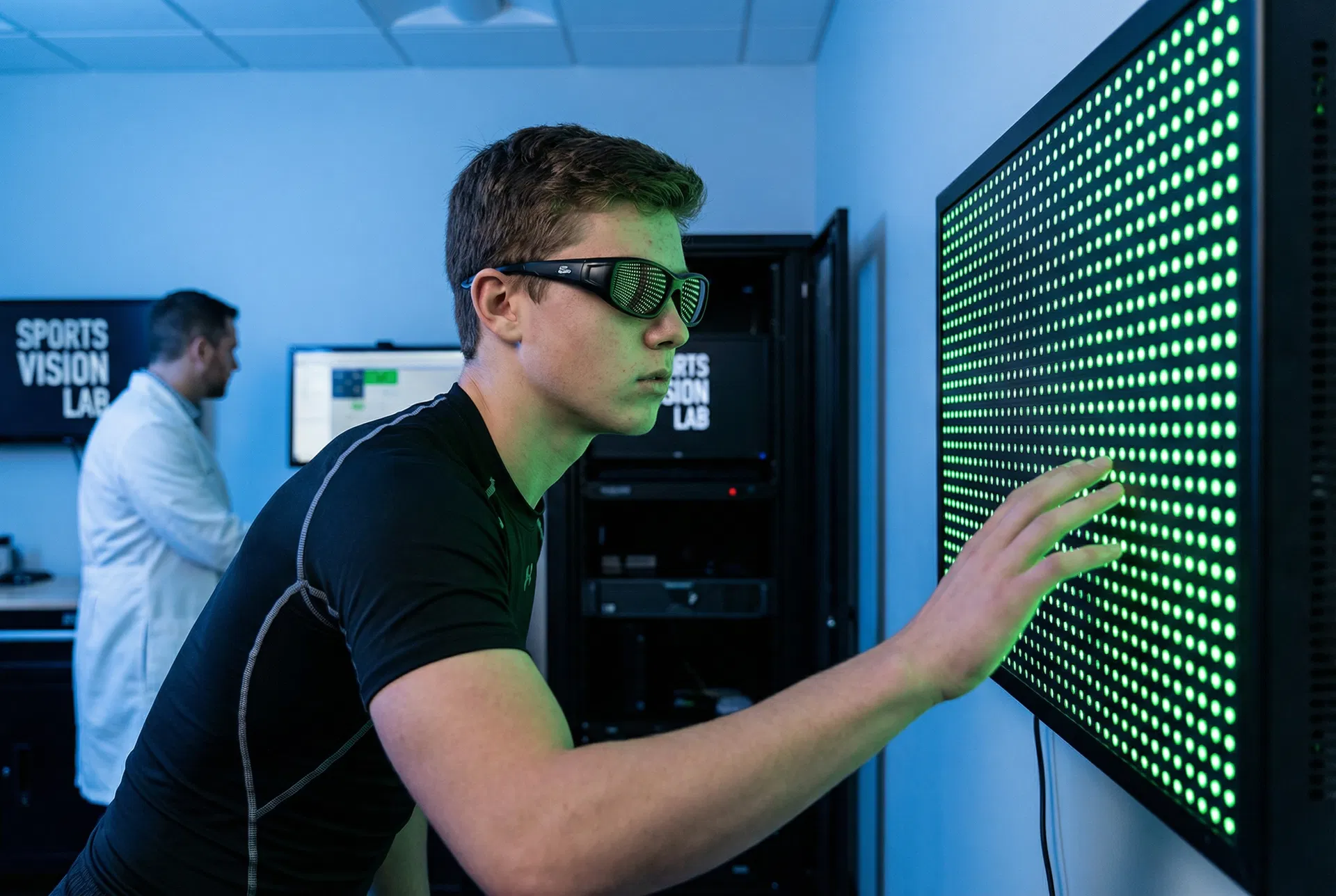
The Fort Liberty community sends us a lot of athletes — high school players from Pine Forest, Terry Sanford, and Gray's Creek, as well as active-duty soldiers and their families who take their physical performance seriously. For all of them, a sports vision evaluation can reveal gaps that no amount of practice will fix on its own.
Dynamic Visual Acuity
Seeing clearly while both you and the target are moving. Static 20/20 doesn't guarantee good dynamic acuity.
Depth Perception (Stereopsis)
Judging distances in 3D. Depends entirely on healthy binocular vision — if the eyes aren't teaming, depth perception suffers.
Peripheral Vision
Elite athletes maintain awareness of the entire field. Peripheral training can expand effective visual field and improve situational awareness.
Reaction Time
The visual component of reaction time — from seeing a stimulus to initiating a motor response — can be measured and trained.
The research is clear: elite athletes have measurably better visual systems than non-athletes, and visual skills can be improved through targeted training. A 2019 review in the Journal of Sports Science & Medicine found that sports vision training programs produced significant improvements in dynamic visual acuity, reaction time, and sport-specific performance metrics across multiple disciplines.
What Happens During a Visual Analysis Exam?
A Visual Analysis exam at Eye Medics is not a quick appointment. Plan for 60–90 minutes, sometimes more for complex cases. Here's what we cover:
Case History
We spend real time with you. We want to know about reading habits, school performance, sports involvement, and any symptoms you've noticed.
Standard Refraction
We always start with a comprehensive refraction to rule out uncorrected refractive error as a contributing factor.
Binocular Vision Testing
Cover testing, vergence testing (convergence and divergence), accommodative testing, and stereopsis (depth perception).
Ocular Motility Assessment
Saccadic eye movements (reading jumps), smooth pursuit (tracking a moving target), and fixation stability.
Visual Processing Battery
Standardized tests for visual memory, discrimination, spatial orientation, and visual-motor integration.
Performance Vision Testing
For athletes or high-demand professionals: dynamic visual acuity, peripheral awareness, and reaction time testing.
Report and Plan
We review findings in plain language and outline a clear treatment plan — prescription update, referral, vision therapy, or a combination.
Who Needs This Exam?
Children
Who struggle with reading, avoid near tasks, lose their place frequently, have been diagnosed with ADHD or a learning disability, or whose teachers report attention or behavior problems in the classroom.
Athletes
At any level who want to optimize visual performance, recover from a sports-related concussion, or address specific visual weaknesses identified by coaches.
Adults
Experiencing unexplained headaches, digital eye strain, difficulty reading for extended periods, or visual symptoms following a concussion or traumatic brain injury.
Military Personnel & Veterans
Concussion and TBI are common in the Fort Liberty community. Visual dysfunction is one of the most frequently overlooked consequences of head injury. Post-concussion vision therapy has strong evidence behind it.
Standard Eye Exam vs. Visual Analysis Exam
A standard comprehensive eye exam is essential — and we perform one as part of every Visual Analysis. But the Visual Analysis goes significantly further in evaluating the functional vision skills that determine how well you see in the real world.
| Feature | Standard Eye Exam | Visual Analysis Exam |
|---|---|---|
| Distance acuity (20/20 test) | ✓ | ✓ |
| Prescription update | ✓ | ✓ |
| Eye health evaluation | ✓ | ✓ |
| Binocular vision testing | Limited | Comprehensive |
| Convergence assessment | Rarely | Always |
| Accommodative testing | Rarely | Always |
| Saccadic / tracking evaluation | — | ✓ |
| Visual processing battery | — | ✓ |
| Sports vision testing | — | Optional add-on |
| Vision therapy planning | — | ✓ |
| Typical duration | 20–30 min | 60–90 min |
| TRICARE coverage | Usually covered | Varies by diagnosis |
Signs Your Child May Have a Visual Problem
Use this interactive checklist to identify potential visual problems. If your child checks 3 or more boxes, a Visual Analysis exam is strongly recommended. You can also download a printable version to share with your child's teacher or pediatrician.
Signs Your Child May Have a Visual Problem
Check all that apply. If 3 or more boxes are checked, a Visual Analysis exam is strongly recommended.
Reading & Learning
Physical Symptoms
Behavior
0 of 17 items checked
Frequently Asked Questions
School screenings test distance acuity only — whether a child can read a chart from 20 feet away. They do not test binocular vision, convergence, visual processing, or any of the near-vision skills required for reading and learning. A child can have 20/20 distance vision and still have significant binocular vision or visual processing problems. The American Optometric Association recommends a comprehensive eye exam by an optometrist, not a school screening, as the standard of care.
References
- 1. Scheiman M, et al. "A Randomized Clinical Trial of Treatments for Convergence Insufficiency in Children." Archives of Ophthalmology, 2005. CITT Study Group / National Eye Institute.
- 2. American Optometric Association. "Convergence Insufficiency." Clinical Practice Guideline. aoa.org
- 3. Quaid P. Learning to See = Seeing to Learn: Vision, Learning & Behavior in Children. 2017.
- 4. Remick K. Eyes on Track: A Manual to Improve Vision Processing. 2017.
- 5. Ciuffreda KJ, et al. "Vision Therapy for Oculomotor Dysfunctions in Acquired Brain Injury." Optometry, 2008.
- 6. Optometric Vision Therapy for Visual Deficits and Dysfunctions: A Suggested Model for Evidence-Based Practice. Vision Development & Rehabilitation, 2015.
- 7. Zwierko T, et al. "Sports Vision Training and Performance." Journal of Sports Science & Medicine, 2019.
Last reviewed: March 2026. Eye Medics Optometry, 910.426.3937. Serving Fayetteville, Fort Liberty, Hope Mills, and Cumberland County, NC.
Medical Disclaimer
This page is for informational purposes only and does not constitute medical advice, diagnosis, or treatment. The information provided here should not be used as a substitute for professional medical advice from a qualified eye care provider. Always consult with a licensed optometrist or ophthalmologist regarding any eye health concerns, symptoms, or treatment decisions.
